 Canada
 United States
Natural care
How to Get Rid of Duckweed in a Pond Naturally
Duckweed is a floating plant, not algae, so the natural fix leads with physical removal and aeration, then cuts the excess nutrients that feed it. Here is the chemical-free plan.
Last updated August 3, 2026
To get rid of duckweed in a pond naturally, start by physically removing what is already floating: skim or rake it off the surface while it is thickest. Then add water movement with aeration, because duckweed thrives on still water and circulation makes the surface less hospitable. Finally, work on the underlying cause over time by lowering the excess nutrients in the water so the plant has less to feed on. Duckweed is a free-floating plant, not algae, so unlike a green bloom it responds first to mechanical removal and moving water rather than to any single treatment.
What duckweed is, and how to tell it from algae
Duckweed (Lemna) is a tiny free-floating vascular plant. Each plant is a rounded green leaf-like frond, often just a few millimetres across, with one or more thread-like roots dangling beneath it. Up close you can see individual plants; scoop a handful and it feels like tiny leaves or grains rather than slime. On a still pond it forms a bright, even, carpet-like green layer that can be pushed around by wind into drifts along a downwind bank.
That physical structure is the key difference from algae, and it changes the whole approach. Filamentous algae looks like green hair, cotton, or slimy mats and pulls apart into stringy strands; planktonic algae simply tints the water green with no visible individual plants. Because duckweed is a true plant with leaves and roots, it responds to being physically lifted out and to surface movement in a way a bloom does not. If you are actually dealing with a green bloom or hair-like mats, our companion guide on how to get rid of pond algae naturally is the better fit.
- Duckweed: distinct tiny floating green fronds with hanging roots; a lumpy, grainy carpet you can scoop by the handful.
- Filamentous algae: hair-like or cottony green strands and mats you can wind around a stick.
- Planktonic algae: no visible plants, just cloudy green-tinted water.
What causes a duckweed takeover: excess nutrients and still water
Duckweed explodes for two reasons that usually occur together: a rich supply of nutrients and calm, sheltered water. Nutrients such as phosphorus and nitrogen accumulate from lawn and field runoff, leaves and grass clippings, waterfowl and fish waste, and organic muck breaking down on the bottom. That nutrient load is essentially fertilizer, and duckweed is one of the fastest-growing plants there is, so a small patch can spread across a surface quickly under the right conditions.
Still water is the second half of the equation. Duckweed floats, so it favours ponds and corners that sit calm, warm, and undisturbed, which is why it so often piles up in a quiet bay while a wind-swept shore stays clearer. A pond that is both nutrient-rich and stagnant is close to ideal for it. This is why treating only the surface never lasts: skimming removes today's growth, but if the nutrients and the stillness remain, the pond keeps handing duckweed everything it needs to come back.
Step 1: Skim and rake the floating duckweed off the surface
Because duckweed is a physical, floating plant, the fastest natural way to knock it back is to remove it by hand. There is no waiting period here: what you lift out today is gone today. A long-handled mechanical rake such as a Cutter 'N' Rake, a pond skimmer net, or even a length of rope or a board dragged across the surface by two people will corral and lift large amounts at once.
Work with the wind. Duckweed drifts downwind, so let it collect against one bank and skim it from there rather than chasing scattered patches. Because the plant reproduces from tiny fragments, aim to remove as much as you reasonably can in a session and repeat over several days, since even a small amount left behind can regrow. Compost the removed material away from the water so nutrients do not wash straight back in. This step gives you the fastest visible win, but on its own it is maintenance, not a cure, which is why steps 2 and 3 matter.
Step 2: Add water movement with aeration to discourage regrowth
Since duckweed prefers calm water, adding movement makes the surface a less comfortable place for it to settle and spread. Aeration, whether from a windmill, solar, or electric aeration system, or a decorative fountain, keeps the water circulating and the surface disturbed so drifting fronds have a harder time forming a static carpet, especially in the sheltered corners where duckweed usually starts.
Aeration also does longer-term work under the surface. By adding oxygen and circulation, it supports the aerobic conditions that help beneficial bacteria break down the organic muck on the bottom, and that muck is a reservoir of the very nutrients duckweed feeds on. So aeration attacks the problem from two directions at once: it disrupts the still water duckweed likes, and it helps chip away at the nutrient supply over time. Position the aeration to move water through the quiet zones where duckweed collects rather than only the open middle. To match a system to your pond's size and depth, our lakes and large ponds and acreages pages walk through the options.
Step 3: Reduce the nutrients in the water over time with beneficial bacteria
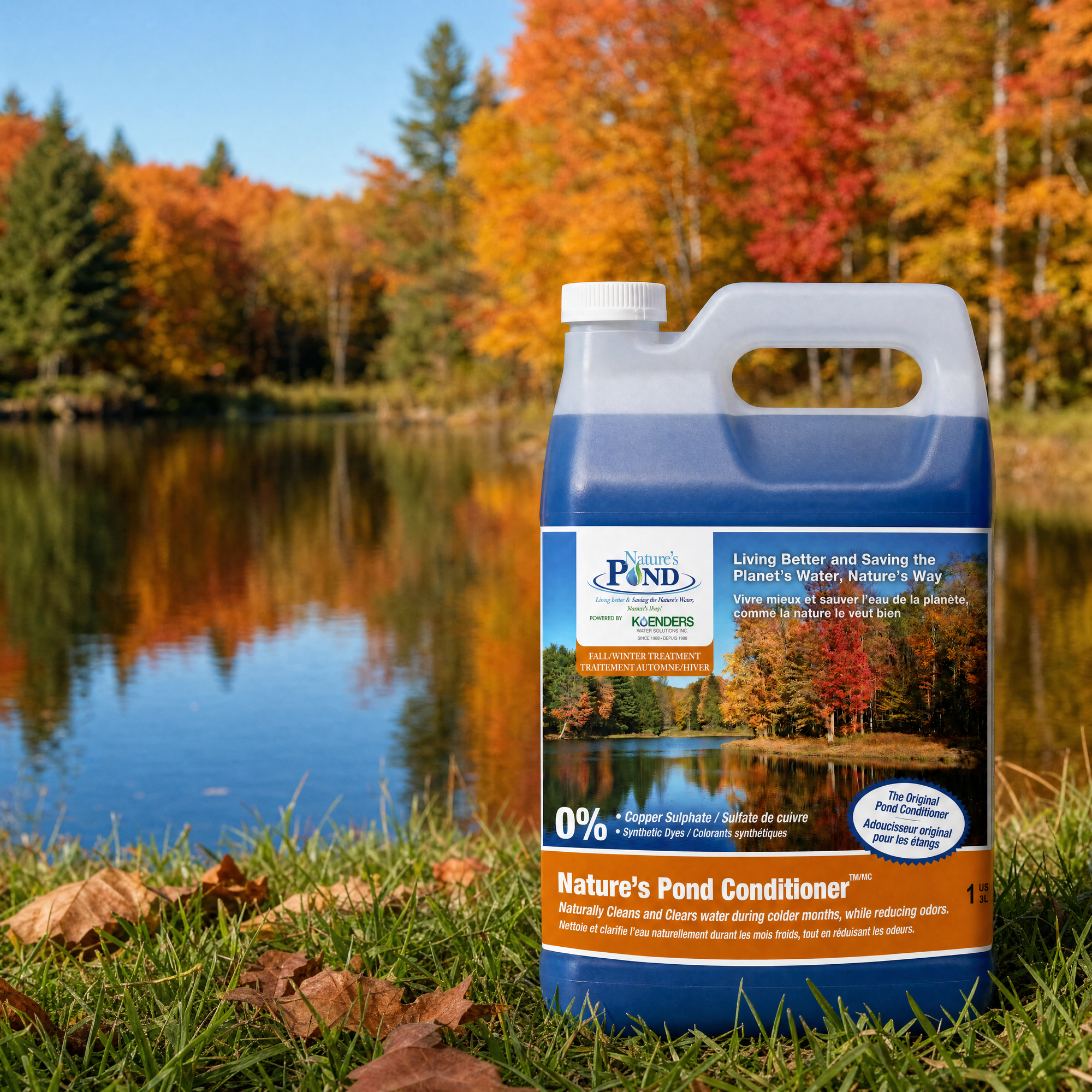
Removal and movement handle the duckweed you can see; the last step goes after its food. Nature's Pond Conditioner is a natural blend of beneficial bacteria and enzymes that digests the organic muck and consumes excess nutrients such as phosphorus and nitrogen in the water. As that surplus nutrient load comes down through the season, there is less fertilizer in the pond for fast-growing plants to exploit. It is safe for fish, pets and wildlife when used as directed.
Set your expectations correctly here. Beneficial bacteria are a supporting step that works on the pond's nutrient balance gradually; they are not a treatment that removes or kills duckweed on their own, and any nutrient effect on a free-floating plant like duckweed is slower and less direct than physical removal or aeration. Think of it as tilting the whole pond toward balance so that, combined with ongoing raking and circulation, duckweed has a harder time dominating year after year. Our pond conditioners collection and the pond dosing calculator help you match the right amount to your water volume.
Why herbicides leave the underlying cause in place
It is tempting to reach for a chemical that promises to wipe out a duckweed layer fast, and much of what you find online pushes exactly that. The catch is that killing the top layer does nothing about why the duckweed was there. The nutrients and still water that grew it are still present, so a chemical knock-down is often followed by regrowth, and you are back to spraying on a treadmill.
There is also a disposal problem. When a dense duckweed mat is killed and left to sink and rot, that decaying plant material settles to the bottom and adds to the muck, which then releases nutrients back into the water, effectively re-fuelling the next flush of growth. Nature's Pond Care takes the opposite approach, chemical-free and aimed at the cause rather than the symptom: remove the plant, move the water, and lower the nutrient load so the pond stops producing conditions that favour duckweed in the first place.
Keeping duckweed from returning next season
Duckweed control is less a one-time fix than an ongoing balance, so the goal is to make your pond a place it struggles to take over. Catch it early: a small patch in spring is far easier to rake out than a full carpet in midsummer, so skim new growth as soon as you notice it, particularly in calm corners. Keep aeration running through the growing season so those quiet zones never stay perfectly still.
Just as important, cut off the incoming nutrients. Reduce lawn and field runoff near the water, keep leaves and grass clippings out of the pond, and maintain a vegetated buffer strip along the shoreline to filter what does run in. Pairing that source control with steady conditioning through the season gives duckweed less and less to feed on year over year. A consistent seasonal routine of aerate, remove, and condition, like the one outlined in the Nature's Pond Care program, is what keeps a pond clear rather than swinging between crisis and cleanup.
Related
FAQ