 Canada
 United States
Natural care
How to Keep a Pond Clean and Clear Naturally (The Complete Guide)
The complete guide to natural pond care: how beneficial bacteria, aeration, and shade work together to treat the cause of green, mucky, smelly water, no chemicals.
Last updated August 3, 2026
To keep a pond clean and clear naturally, you treat the cause of the problem rather than the symptom. Green water, muck, and smell all trace back to one thing: too many nutrients feeding algae and weeds, and not enough oxygen to break the organic load back down. The natural approach works with the pond's own biology through three connected steps: beneficial bacteria to digest muck and consume excess nutrients, aeration to add oxygen and circulation, and natural pond dye to limit the sunlight that growth depends on. Get those three working together and your pond stays clearer through the season without a single harsh chemical.
The natural approach: treat the cause, not the symptom
Most pond problems get treated at the surface. The water turns green, so people reach for an algaecide; the algae dies back for a week or two, then returns, often worse. The reason is simple: knocking back algae at the surface does not remove the nutrients that fed it. The dead algae sinks, rots on the bottom, and adds to the muck and the nutrient load that fuel the next bloom. You end up on a treadmill, treating the same symptom over and over.
Natural pond care breaks that cycle by targeting the root cause. Instead of knocking back the green after it appears, you reduce the food supply and the conditions that let it take hold in the first place. That is the whole philosophy behind Nature's Pond Care, and it has been since 1988: treat the cause, not the symptom. The result is a pond that trends clearer over time rather than lurching between crashes and rebounds.
Why ponds go green, mucky, or smelly: the nutrient loop explained once
Every common pond complaint shares one engine. Nutrients, mainly nitrogen and phosphorus, enter your pond from lawn and field runoff, fertilizer, leaves, grass clippings, fish waste, and dying plant matter. Those nutrients are food. Algae and aquatic weeds feed on them and grow. When that growth dies, it sinks to the bottom and decomposes into a layer of organic sludge, the muck.
Here is the loop that catches most pond owners: decomposition consumes oxygen and releases nutrients back into the water, which feeds the next round of algae and weeds. Low oxygen also slows the natural breakdown of muck, so the sludge layer thickens. As it builds, decomposition can turn anaerobic (oxygen-starved), and that is what produces the rotten-egg smell of a neglected pond. Green water, thick muck, and bad odour are not three separate problems. They are three faces of the same nutrient-and-oxygen imbalance.
Once you see the loop, the fix becomes obvious. You need to remove nutrients from the system, speed up the breakdown of the organic load, keep oxygen levels up, and limit the sunlight that photosynthetic growth relies on. That is exactly what the three-part natural system does.
The three-part natural system: bacteria, aeration, and shade
Natural pond care is not a single product; it is three tools that reinforce each other. Beneficial bacteria digest muck and consume excess nutrients. Aeration supplies the oxygen those bacteria need to work and keeps the whole water column circulating. Natural pond dye limits how deep sunlight penetrates, reducing the light available to algae and submerged weeds.
The key word is together. Bacteria work far better in oxygen-rich water, so aeration multiplies what your conditioner can do. Dye reduces the sunlight driving new growth while the bacteria draw down the nutrients already in the water. Rely on any one of the three alone and you are only addressing part of the loop. Use all three and each step covers the gap the others leave, which is why the system trends toward clearer water rather than a temporary knockdown.
Beneficial bacteria: digesting muck and excess nutrients
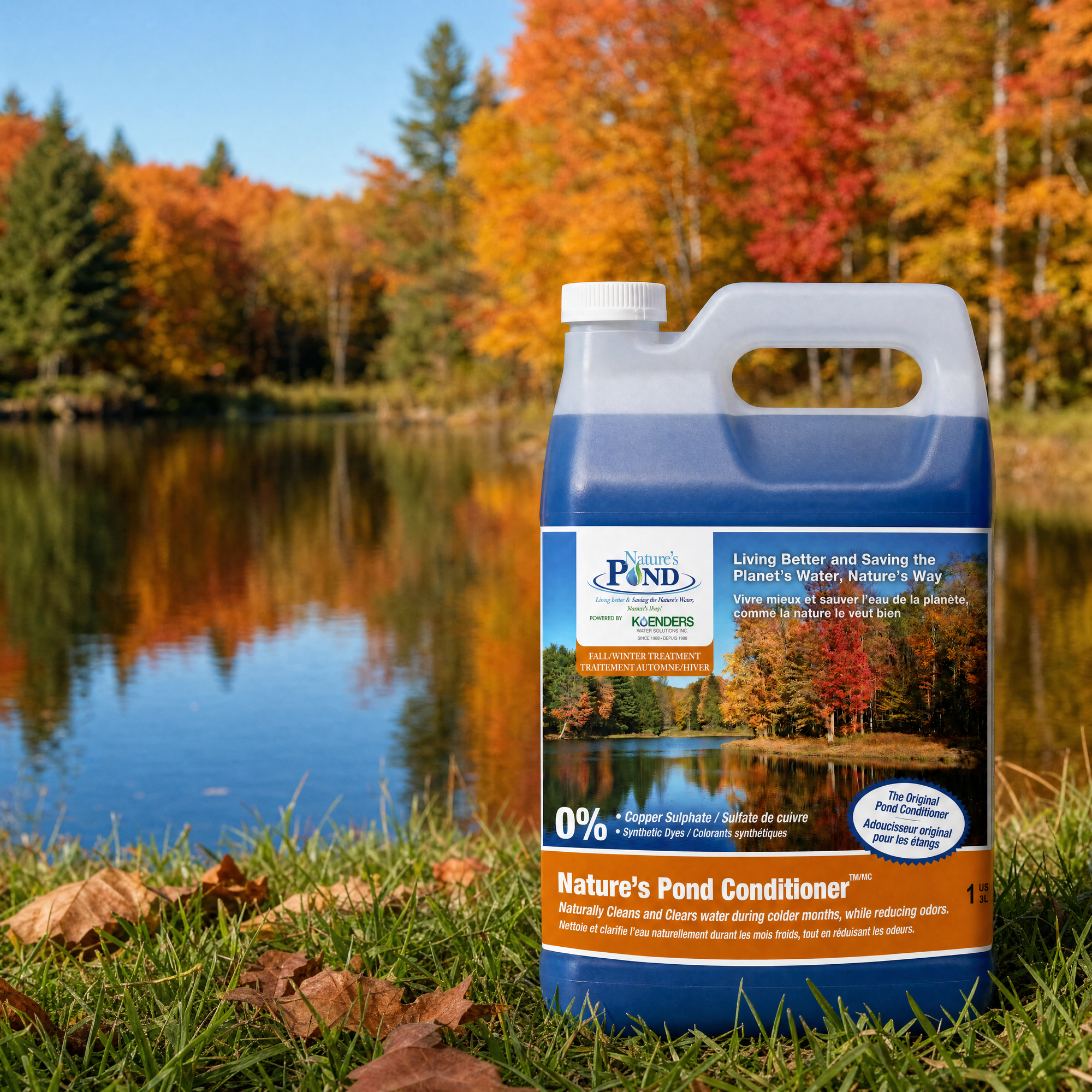
Beneficial bacteria and enzyme conditioners are the workhorses of natural pond care. They are naturally occurring microbes that digest organic matter, the leaves, waste, and dead plant material that settle as muck, and consume the excess nitrogen and phosphorus dissolved in the water. As they draw down that nutrient load, algae and weeds lose the food source they depend on, so growth is less able to take hold.
This is a biological process, not a chemical one. The bacteria are not an algaecide and they do not kill anything; they simply out-compete nuisance growth for the same nutrients while breaking the muck layer back down. Because it works with the pond's biology, a good conditioner is safe for fish, pets, and wildlife when used as directed. It also means results build gradually. You are shifting the pond's balance over a few weeks and through the season, not forcing an overnight crash.
For a deeper walkthrough of how conditioning tackles the two most common complaints, see our companion guides on clearing algae and reducing muck, both linked below.
Aeration: oxygen and circulation that make everything work
Aeration is the step most pond owners underestimate, and it is arguably the most important. Adding oxygen and moving the water does three things at once. It gives beneficial bacteria the dissolved oxygen they need to digest muck efficiently. It circulates the water so those bacteria, oxygen, and nutrients are not stuck in dead zones. And it discourages the stagnant, oxygen-starved bottom conditions that produce muck build-up and foul smell.
Nature's Pond Care offers windmill, solar, and electric aeration, plus decorative fountains that aerate while they look good. Windmill aeration is popular for remote acreage and farm ponds with no power at the water's edge; solar suits off-grid sites; electric and fountains suit properties with power nearby. The right choice depends on your pond's size, depth, and access to power. Whatever the source, aeration is what turns bacteria and dye from isolated treatments into a working system.
Natural pond dye: limiting the sunlight growth depends on
Natural pond dye is a simple, effective piece of the puzzle that is often misunderstood. It tints the water a natural blue or blue-green shade that limits how far sunlight penetrates below the surface. Algae and submerged aquatic weeds rely on that light for photosynthesis, so reducing it makes conditions less favourable for growth, especially the deeper weeds and bottom-growing algae that thrive in clear, sunlit water.
It is important to be precise about what dye does and does not do. Dye is a shading tool, not an algaecide. It does not kill algae or weeds; it limits the sunlight they depend on so growth is slower to establish, giving your bacteria and aeration time to draw the pond back into balance. Used as directed, it is safe for fish, pets, and wildlife, and it is formulated to disperse through the water without staining the pond edge or livestock; follow the product label for application details. Think of it as turning down the lights on the growth you are trying to starve.
Mechanical removal: raking weeds and string algae
Biology takes time, and sometimes you have a mat of string algae or a stand of weeds you want gone today. That is where mechanical removal fits. A tool like the Cutter 'N' Rake lets you cut and pull surface weeds and floating algae mats out of the water by hand, a chemical-free way to get an immediate visual result while the bacteria, aeration, and dye do their slower work underneath.
Physically removing growth has a second benefit that fits the whole philosophy: every rake-full you pull out is nutrients and future muck taken out of the pond entirely, rather than left to die, sink, and rot. Mechanical removal is not a standalone cure, but as a complement to the three-part system it speeds things along and stops big mats from decomposing back into the loop.
Matching the system to your pond (acreage, cottage, koi, lake)
The three-part system is the same everywhere, but how you apply it changes with the type of water body. Larger acreage and lake owners lean heavily on robust aeration to keep a big volume circulating, and often pair windmill or multiple diffusers with regular conditioning. Cottage and recreational pond owners usually want swim-friendly clarity and low-maintenance routines. Koi and ornamental keepers prioritize gentle, fish-safe balance and steady water quality over aggressive treatment.
The principle to remember: bigger and deeper ponds need proportionally more aeration and conditioning, and heavy nutrient inputs (livestock, farm runoff, lots of fish) mean you are fighting a larger food supply. Our sector pages for lakes and large ponds, acreages, and koi and ornamental ponds break down what the natural system looks like for each situation. If you are unsure where your pond fits, reach out through our contact page and we will help you scope it.
A season-by-season natural care rhythm
Natural pond care follows the seasons because the biology does. Beneficial bacteria are most active in warmer water, so the core of your program runs through the warmer months when nutrients and growth are at their peak.
In spring, as the water warms and the pond wakes up, you begin conditioning to get ahead of the season's first growth and add dye early to limit light before algae establishes. Through summer, you maintain regular conditioning, keep aeration running to hold oxygen up in the heat, top up dye, and rake out any weed or algae mats as they appear. In autumn, reducing the leaf litter and dead plant matter entering the pond limits the nutrient load that carries into next year. Over winter, activity slows with the cold, and aeration in freezing climates is often run to help maintain a gas exchange opening in the ice rather than for circulation.
The exact products, quantities, and timing for your climate are best confirmed against the label and your local conditions, so treat this rhythm as the shape of a program rather than a fixed schedule.
Sizing each step with the dosing calculator
The one number that drives everything is your pond's volume. It determines how much conditioner and dye you need and how much aeration will keep the water circulating. Guessing here is the most common reason a natural program underperforms: under-dose and you are not shifting the nutrient balance; over-buy and you are wasting product.
Our pond dosing calculator turns your pond's dimensions into the right quantities for each step, so you can size bacteria, dye, and aeration to your actual water body rather than eyeballing it. Start there, then browse the full range or the ready-made pond care program to put the three-part system together. If your pond is unusual in shape or you have a heavy nutrient source, contact us and we will help you get the sizing right.
Related
FAQ