 Canada
 United States
Natural care
Does Pond Dye Actually Work? The Honest Science on Algae Control
Pond dye works as a shade tool, not a cure. Here is the honest science on what dye can slow, what it can't touch, and why your dye isn't working.
Last updated August 31, 2026
Pond dye works as a shading tool, not a cure. By filtering sunlight it can slow submerged algae and weeds, and it works best applied early, before growth takes off, in water deep enough to shade. It will not clear an existing bloom, floating duckweed, cattails, or toxic blue-green algae.
Ask ten pond owners whether pond dye works and you will get ten different answers. One swears it kept the water clear all summer. The next says it did nothing but turn a green pond a darker shade of green. Both can be right, because they were asking dye to do two very different jobs. This is the honest version, grounded in what aquatic extension research actually shows dye can and cannot do.
The short answer: pond dye works as a shade tool, not a cure. It filters the sunlight that submerged plants and algae need for photosynthesis, so it can slow new growth below the surface. It is not a herbicide or an algaecide. It will not clear a bloom that is already there, and it cannot touch anything floating on top of the water where the light is unfiltered.
How pond dye actually works
Pond dye is a concentrated, water-soluble colorant, usually blue, black, or a blue-black mix, that tints the whole water column. Think of it as sunglasses for your pond. Sunlight drives photosynthesis, and photosynthesis is how algae and submerged weeds grow. By absorbing and scattering the light wavelengths those plants rely on, dye reduces how much usable light reaches the deeper water.
That is the entire mechanism. Dye does not poison algae, it does not add oxygen, and it does not remove the nutrients that feed a bloom. It simply makes the water below the surface a darker, dimmer place to try to grow. That distinction is the key to understanding every success and every disappointment people report.
Dye limits the light plants need to grow. It does not kill what is already growing, and it cannot reach what floats on top.
Where pond dye works well
Dye earns its keep in one specific scenario: slowing submerged algae and weeds in water that is deep enough to shade, when it is applied early, before the growing season takes off. In those conditions the dimmed light column genuinely holds back new bottom growth, and many pond owners see clearer, less weedy water through the summer as a result.
- Submerged, filamentous, and bottom-rooted growth in deeper water, where shading the column actually reaches the plants trying to grow.
- Ponds treated early in spring, before submerged plants and algae have started their fast growth for the year.
- Ponds deep enough to shade, where light does not simply reach the bottom regardless of tint.
- As a finishing layer on top of aeration and a beneficial-bacteria program, holding down new growth while the root cause is being fixed.
Used this way, dye is a legitimate preventive tool. The trouble starts when owners reach for it to fix a pond that is already green.
Where pond dye fails
Most of the disappointment with pond dye comes down to using it against targets it physically cannot affect. Here is where it falls short and what actually controls each problem.
| Target | Does dye help? | What actually controls it |
|---|---|---|
| Submerged algae and weeds (deep water) | Yes, as prevention | Dye plus aeration and beneficial bacteria |
| An existing green bloom | No | Lower nutrients and raise oxygen: bacteria + aeration |
| Blue-green algae (cyanobacteria) | No | Fix the nutrient and oxygen imbalance; treat as a safety issue |
| Duckweed and floating plants | No | Mechanical removal plus fixing the nutrient load |
| Cattails and lilies (emergent) | No | Targeted removal; dye cannot shade leaves in full sun |
| Surface scum and mats | No | Address the bloom cause, then skim or rake |
Existing blooms and surface scum
Dye cannot remove algae that is already there. Pour it into a green pond and you get a darker green pond. Worse, dyeing an already-heavy pond can add risk: as shaded plants die back and decay, that decomposition pulls oxygen out of the water and can stress or kill fish. If your pond is already green, the fix is to lower the nutrient load and raise oxygen first. You can clear green pond water naturally by treating the cause, then let dye help prevent the next flush.
Blue-green algae (cyanobacteria)
Blue-green algae, which is really cyanobacteria, floats at or near the surface where sunlight is unfiltered, so dye does nothing to stop it. This matters for more than looks: some cyanobacteria produce toxins that are dangerous to dogs, livestock, and people. Never rely on dye for a suspected blue-green bloom. Treat it as a safety issue, keep animals and children away, and address the underlying nutrient and oxygen imbalance.
Duckweed and floating plants
Duckweed sits on the surface and soaks up full, unshaded sun, so tinting the water beneath it changes nothing. Duckweed is controlled mechanically and by starving it of the excess nutrients it thrives on. If a green carpet is creeping across your pond, see how to get rid of duckweed naturally rather than reaching for more dye.
Cattails, lilies, and emergent plants
Emergent plants push leaves and stems above the waterline into full sunlight. Shading the water column below them has no meaningful effect on plants that photosynthesize in the open air. These need targeted removal, not colorant.
Why isn't my pond dye working?
If you added dye and the pond is still a mess, the reason is almost always one of these. None of them mean dye is a scam, they mean it was pointed at the wrong problem or applied the wrong way.
- The pond was already green when you dyed it. Dye prevents new submerged growth. It cannot reverse a bloom that is already established.
- The water is too shallow to shade. In shallow water, enough light reaches the bottom no matter how you tint it.
- It was underdosed for the true volume. Most people dose by surface acres and forget depth. Dose is set by acre-feet, not acres.
- Heavy inflow diluted it out. A stream, spring, heavy rain, or an outflow flushes dye through quickly and washes the color away.
- The target floats on the surface. Duckweed, surface scum, and cyanobacteria live where dye cannot reach.
The volume mistake is the most common of all. Getting the how much dye you'll need right starts with measuring acre-feet: surface acres times average depth in feet, divided by four. A one-acre pond averaging five feet deep is five acre-feet, and it needs far more dye than a one-acre pond that is only two feet deep. Underdose first, because you can always add more but you cannot take dye back out.
The honest fix: dye is one tool, not the whole plan
A pond that turns green year after year is telling you something: it has too many nutrients (phosphorus and nitrogen), too little dissolved oxygen, and a layer of anaerobic muck on the bottom feeding the whole cycle. Dye does not touch any of those root causes. It manages light. That is why dye alone leaves so many owners frustrated, and why the durable answer is to fix the water, then use dye to keep new growth down.
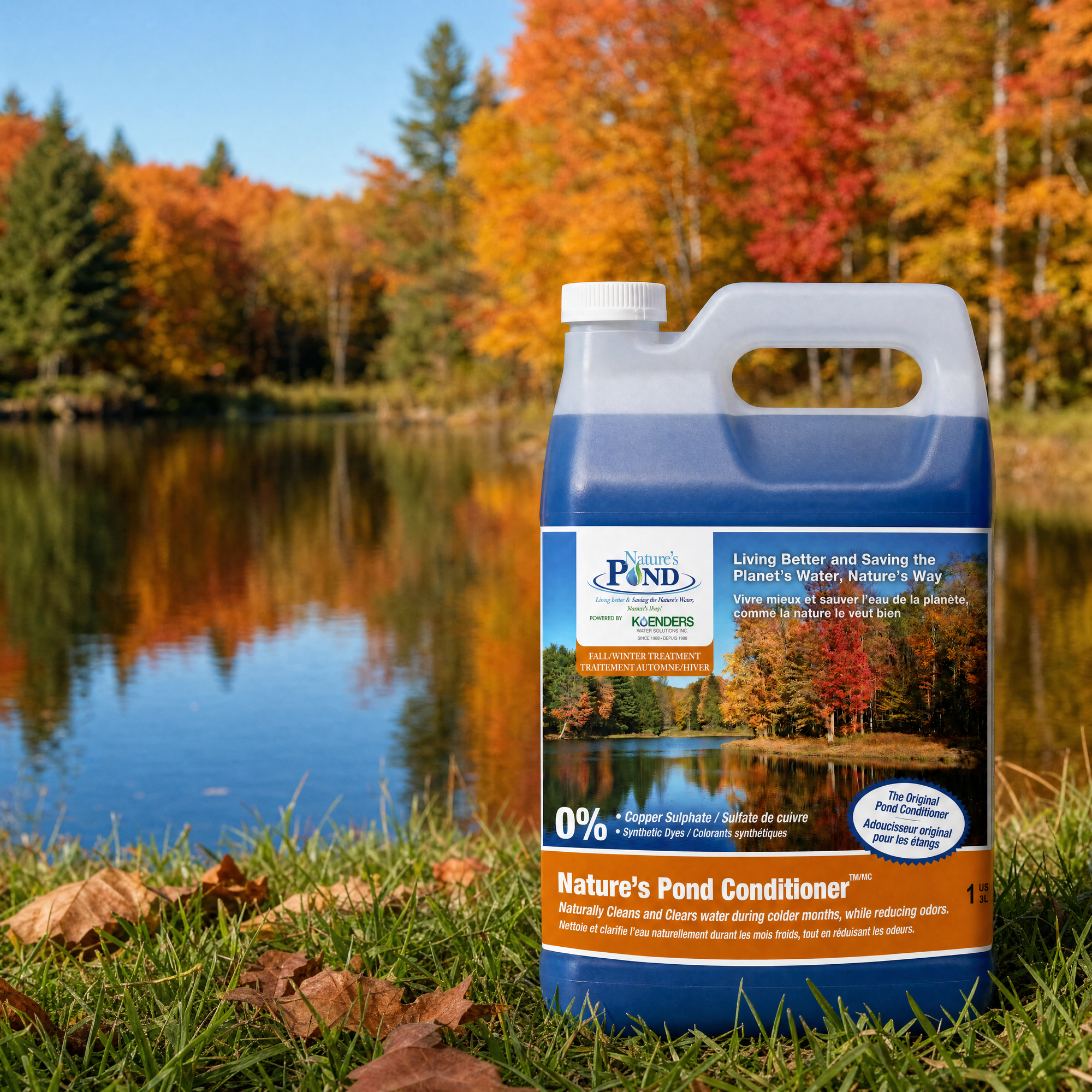
That is exactly what the 3-step Pond Care Program does. Renew conditions the water with an all-natural blend of beneficial bacteria and enzymes that digest the organic muck and outcompete algae for nutrients. Revive adds aeration so the water holds the oxygen those bacteria need to work and the bottom stops going septic. Remove clears the debris and weeds dye and biology cannot reach.
| Approach | What it does | What it leaves undone |
|---|---|---|
| Pond dye alone | Shades submerged growth; natural look | Nutrients, oxygen, muck, and anything floating |
| Beneficial bacteria | Digests organic muck; competes with algae for nutrients | Needs oxygen to work fast; slower than a chemical |
| Aeration | Adds dissolved oxygen; circulates and destratifies | Does not shade light or remove debris on its own |
| All three together | Treats cause and symptom; durable clear water | Requires setup and a full season to hit its stride |
The beneficial-bacteria pond conditioner does the heavy lifting on nutrients and muck, and once the pond is balanced a natural pond dye becomes a genuinely useful finishing layer rather than a hopeful cover-up. If you want a straight answer on what your specific pond needs, our in-house pond experts will give you a free recommendation when you contact us.
Is pond dye a waste of money?
No, but it is a maintenance tool, not a fix. Used correctly, early, at the right dose, on the right target, and as part of a balanced plan, dye does a real job and keeps a natural look. The owners who feel they wasted their money are almost always the ones who bought dye expecting it to clear a chronic bloom on its own. It never could. Aeration plus a biological program addresses the cause; dye finishes the picture.
If you are weighing color options while you are here, blue vs black pond dye walks through the trade-offs (all colours dose and behave the same way), and our complete pond dye guide covers safety, dosing, and timing in one place.
Dye is not a cure and it is not a scam. It is a shade tool. Use it as one, and it earns its place. Ask it to fix the pond alone, and it will disappoint you every time.
The bottom line
Does pond dye work? Yes, at the one thing it is built to do: filtering light to slow submerged growth, applied early, in deep enough water. It does not clear an existing bloom, it does not touch duckweed or cattails, and it does no good against toxic blue-green algae floating on the surface. Treat dye as the finishing layer on top of oxygen and biology, not as the plan itself, and you will finally see the clear water you were promised.
Related
- The 3-step Pond Care Program Renew, Revive, Remove for durable clear water
- Beneficial-bacteria pond conditioner Digests muck and starves algae of nutrients
- Shop natural pond dyes Blue, black, and blue-black shading colours
- Get rid of string algae The correct fix for an existing bloom
- Get rid of duckweed naturally Why dye cannot touch floating plants
- Complete pond dye guide Safety, dosing, and timing in one place
FAQ