 Canada
 United States
Diagnostic guide
Pond Spring Turnover and Stratification Explained (Muddy Water, Green Water and Startup)
Why your pond looks muddy or green after ice-out, whether it is dangerous, and how to restart it the natural way with aeration and cold-water bacteria.
Last updated August 31, 2026
Spring pond turnover is when water warming toward 4C flips the winter layers and mixes bottom sediment, so the pond looks muddy or green after ice-out. It is usually normal and temporary. Restart the pond by resuming aeration and adding cold-water beneficial bacteria as the water warms toward 48-50F, rather than reaching for algaecide.
You cleared the last of the ice off your pond, walked down for a first look at spring, and the water is a murky brown or a soupy green that was not there in the fall. Before you panic or reach for a jug of algaecide, take a breath. What you are almost certainly seeing is spring turnover, a normal seasonal event, and in most ponds it sorts itself out on its own with a little help.
This guide explains what spring turnover and stratification actually are, why the water looks off after ice-out, whether any of it is dangerous for your fish, and how to restart your pond by working with the water temperature instead of fighting it.
What spring turnover is (and why the water looks off)
Through the winter, a pond does not mix. It settles into layers, or stratifies, and those layers barely move under the ice. As spring sunshine returns and the water warms, those layers become unstable and flip over. That mixing event is spring turnover, and the churned-up bottom sediment is exactly why the water suddenly looks muddy, cloudy, or discoloured.
Stratification and the 4C density flip explained
Water is at its densest, and therefore heaviest, at about 4C (39F). That single quirk of physics drives the whole seasonal cycle. Under winter ice, the coldest water near 0C sits at the top against the ice while slightly warmer, denser 4C water sinks to the bottom. As spring sun warms the surface back up through 4C, the top water becomes heavier than the water below it and sinks, while lighter water rises. The whole column overturns and mixes from top to bottom. That is the flip, and it lifts a season's worth of settled sediment and dissolved gases up with it.
Muddy water after ice-out is usually mixing, not a problem
The brown, stirred-up look that follows the flip is suspended sediment, not a disease and not a chemical you need to counteract. It is the visible signature of the pond doing exactly what it is supposed to do in spring. In most ponds the sediment settles back out within days as the water column stabilizes.
Muddy or green water at ice-out is usually the pond restarting itself, not a crisis. Give it time, oxygen, and biology before you reach for a chemical.
Is spring turnover dangerous?
Spring turnover is usually the milder of the two annual turnovers. Cold spring water naturally holds more dissolved oxygen than warm summer water, and the whole event happens while temperatures are still low, so the oxygen swing is gentler than what you see in fall turnover, when a warm, oxygen-rich surface suddenly mixes down into a large, oxygen-starved bottom layer.
That said, any turnover briefly mixes low-oxygen bottom water through the pond, so it can still stress fish for a short window. Running gentle aeration through the transition keeps dissolved oxygen from dipping and helps the pond settle faster. The goal in spring is a steady, mixed water column, not a shocked one.
The spring algae bloom is usually temporary
The other thing that unsettles owners at ice-out is green water. As the sun returns and winter decomposition releases nutrients like phosphorus and nitrogen into the water, algae get a brief head start before everything else in the pond wakes up. The result is an early-season bloom that looks alarming and usually is not.
As the water keeps warming and beneficial bacteria and aeration re-establish, that first bloom typically fades on its own. Bacteria and algae both feed on the same nutrients, so once your biology is active again it competes the algae back down. A green tint at ice-out that clears within a couple of weeks is a normal spring pattern, not a sign your pond is broken.
Why nuking it with algaecide backfires
It is tempting to hit an early bloom with copper algaecide and be done with it. The problem is what happens next. Copper kills the algae, but the dead algae then sinks, rots on the bottom, and releases its stored nutrients right back into the water, which fuels the next bloom a few weeks later. You end up on a treadmill: treat, re-bloom, treat again, while copper accumulates in the sediment.
Addressing the nutrients that feed algae, rather than repeatedly killing the algae itself, is the durable path. That is the whole idea behind treating the cause instead of the symptom, and it is why we lean on aeration plus biology over chemicals. See the difference laid out below.
| Cold-water beneficial bacteria | Copper algaecide | |
|---|---|---|
| How it works | Digests the organic muck and nutrients that feed algae | Kills living algae on contact |
| Effect on muck and nutrients | Reduces the organic nutrient load over time | Dead algae sinks, rots, and re-releases nutrients |
| Effect on the next bloom | Starves the next bloom of its food | Refuels the next bloom as it decays |
| Safety for fish and livestock, used as directed | Safe for fish, pets, livestock and wildlife | Copper is toxic to fish and accumulates in sediment |
| Lifetime cost | Lower over multiple seasons: fixes the cause | Recurring: you re-treat every bloom |
How to restart your pond (temperature-driven)
The single best habit for spring startup is to stop watching the calendar and start watching the water temperature. A warm March and a frozen April can arrive in the same region in different years, so a thermometer in the pond tells you far more than a date. Two thresholds matter most in spring.
When to add cold-water bacteria (near 48-50F)
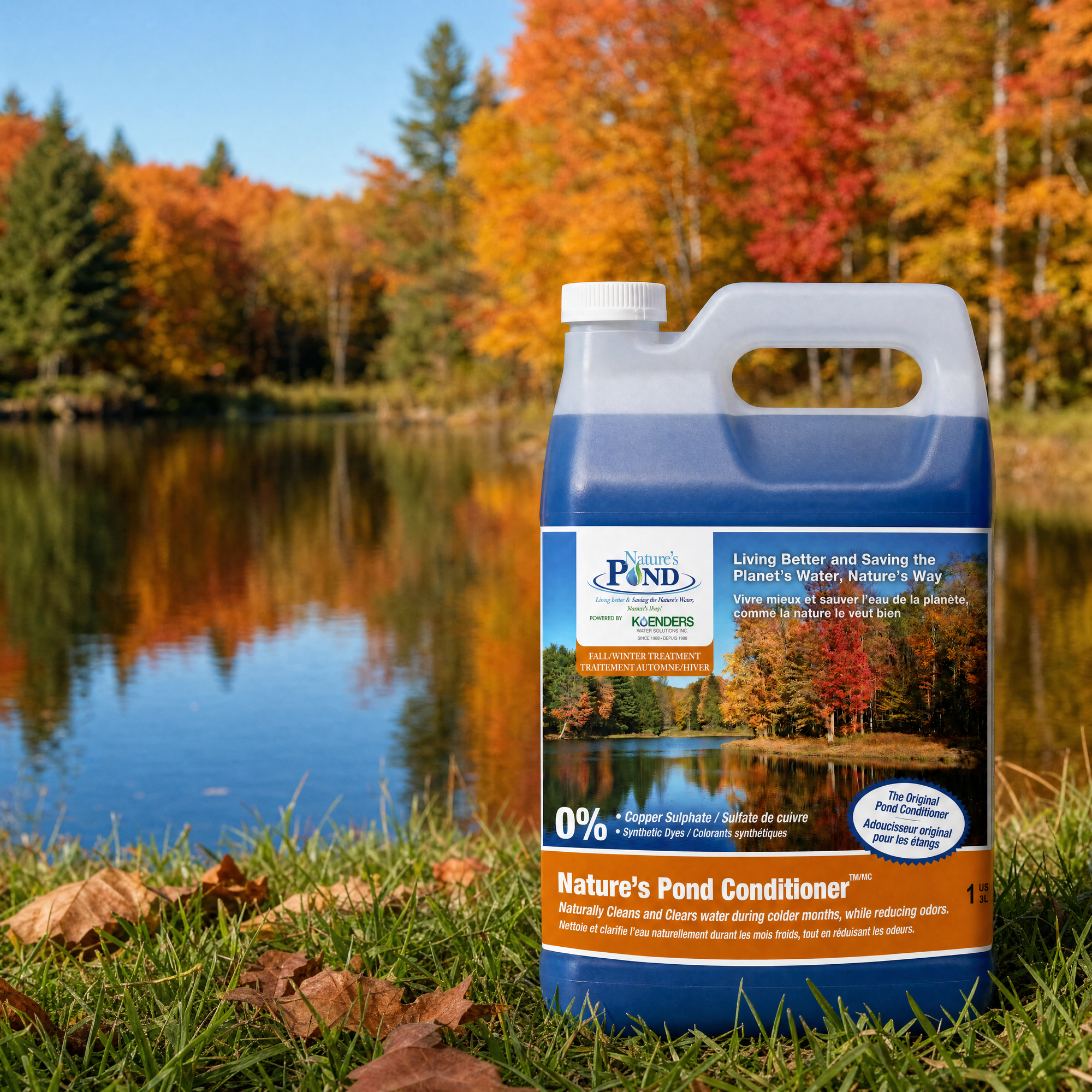
Beneficial bacteria are living organisms, and they only get to work once the water is warm enough. Cold-water blends begin to activate as the water climbs toward about 48-50F. Below that, biological activity is slow, so dosing much earlier mostly wastes product without giving you a head start. Wait for the water to warm into that range, then add Nature's Pond Conditioner, our all-natural blend of aerobic and anaerobic beneficial bacteria, enzymes, and plant extracts that converts organic waste into carbon dioxide and water. As the pond keeps warming past 50F, warm-water activity picks up and the biology works faster. For more on the mechanism, see how beneficial bacteria work.
When to restart aeration
Aeration is the other half of a clean spring startup. Bringing your aerator back online as the pond opens up keeps dissolved oxygen steady through the turnover window and circulates the water so your bacteria have the oxygen they need to do their job. Aerobic bacteria digest muck far faster than starved anaerobic ones, so oxygen and biology are a pairing, not an either/or. Restart aeration as the ice clears and the pond begins to warm, and let it run steadily through the spring transition.
- Put a thermometer in the pond and track the water temperature, not the date on the calendar.
- Restart aeration as the ice clears so oxygen stays steady through turnover.
- Wait for the water to warm toward about 48-50F, then add cold-water pond conditioner.
- Give an early green or muddy bloom a couple of weeks to fade before considering anything else.
- Skip the algaecide, and let aeration plus biology out-compete the bloom at its source.
These steps are the spring leg of the 3-step Pond Care Program: Renew the water with conditioner, Revive it with aeration, and Remove what mechanical and biological methods can take out over the season. For a full opening walkthrough, work through the spring pond startup checklist.
How long spring turnover and green water last
In most ponds, the turnover itself is a short transition of a few days to a couple of weeks as the water mixes and stabilizes, and the muddy look clears as sediment settles. An early algae bloom follows a similar timeline once your bacteria and aeration are active and competing for nutrients.
The signal to pay closer attention is persistence. Green or muddy water that hangs on for many weeks, or comes back bloom after bloom, is usually pointing at an underlying nutrient or muck problem rather than a passing spring event. That is a cause worth addressing biologically over the season rather than masking, and it is exactly the kind of thing our team can help you read. If you are unsure what your pond is telling you, contact our pond experts for a free recommendation.
Frequently asked questions
Related
- The Complete Seasonal Pond Care Calendar Year-round pond care by water temperature
- Spring pond startup checklist Step-by-step opening for spring
- Fall pond turnover The overnight fish kill you can see coming
- What beneficial bacteria do for a pond How the biology clears your water
- Nature's Pond Conditioner All-natural cold-water pond bacteria
- The 3-step Pond Care Program Renew, Revive and Remove
FAQ