 Canada
 United States
Diagnostic guide
Blue-Green Algae and Cattle: How to Spot a Toxic Bloom Before It Kills Your Herd
Toxic blue-green algae can kill cattle within hours and has no antidote. Learn to identify a bloom, act fast, and prevent it at the source.
Last updated August 31, 2026
Blue-green algae (cyanobacteria) can produce toxins lethal to cattle. According to University of Nebraska extension, poisoning signs can appear within about 20 minutes of drinking, and death can follow within 2 to 24 hours, with no antidote. Suspect any thick, paint-like or pea-soup scum, fence animals off immediately, and call your veterinarian.
Every summer, ranchers lose animals to water that looked fine a week earlier. A stock pond or dugout warms up, a green film spreads across the downwind corner, and cattle drinking there start to go down fast. The cause is often blue-green algae, and unlike ordinary pond scum, a toxic bloom can kill an animal before you have time to react. This guide helps you tell a dangerous bloom from a harmless one, act quickly if you suspect poisoning, and prevent blooms from forming in the first place.
What blue-green algae is (and what it isn't)
"Blue-green algae" is a common name for cyanobacteria, which are not true algae at all but photosynthetic bacteria that live in almost every waterbody. Most of the time they sit in the background at harmless levels. The problem starts when warm water, still conditions, and a surplus of nutrients let them multiply explosively into a bloom that can cover the surface in days.
Some cyanobacteria strains produce potent toxins. Others do not. You cannot tell the two apart by looking, and a bloom that was safe last week can turn toxic as its makeup shifts. That uncertainty is exactly why extension specialists tell producers to treat any heavy bloom as dangerous until it is proven otherwise.
It also helps to know what blue-green algae is not. The stringy, hair-like green mats that cling to rocks and rake up in clumps are filamentous green algae, a nuisance and a warning sign but usually not a poisoning risk. If you want the full picture on the ordinary green stuff, see our clean livestock water guide. The toxic type looks different, and that difference can save your herd.
How to identify a toxic bloom
A toxic cyanobacteria bloom usually has a distinctive look. Watch for these signs, especially from mid-summer into early fall:
- Spilled-paint appearance: the water looks like someone poured bright green, blue-green, or turquoise paint across the surface.
- Pea-soup color: a thick, opaque green throughout the top few inches rather than clear water with scattered strands.
- Scum on the downwind edge: wind pushes the bloom into a concentrated mat along the leeward shore, which is exactly where thirsty cattle wade in to drink.
- A blue-green film or crust that can look almost like spray paint or grass clippings once it dries at the water line.
- A sudden onset: blooms can thicken dramatically in a day or two of hot, calm weather.
Contrast that with common filamentous green algae, which looks like green hair, cotton, or slime you can lift on a stick. The comparison below lays the two side by side.
| Trait | Blue-green (cyanobacteria) | Green / filamentous algae |
|---|---|---|
| Appearance | Paint-like, pea-soup, or turquoise scum on the surface | Hair-like strands, mats, or slime you can lift out |
| Where it collects | Blown into a thick mat on the downwind shore | Clings to rocks, edges, and the bottom |
| Toxicity to cattle | Can be lethal; some strains produce toxins | Usually non-toxic; a nuisance and palatability issue |
| Onset if toxic (per UNL) | Signs within about 20 minutes; death in 2 to 24 hours | Not applicable |
| What to do | Fence off, deny access, call your vet, test the water | Manage the nutrients and oxygen that feed it |
You cannot confirm toxicity by sight alone, so treat any thick, paint-like scum as dangerous until it is tested or cleared.
Symptoms and timeline in cattle
Cyanotoxins act fast and there is no antidote, which is what makes blue-green algae so dangerous compared with the slower nuisance problems. According to University of Nebraska extension, poisoning signs can appear within about 20 minutes of an animal drinking contaminated water, and death can follow within 2 to 24 hours depending on the toxin and the dose.
Depending on which toxin is present, producers and veterinarians commonly report signs such as staggering, muscle tremors, weakness or collapse, laboured breathing, and sudden death, sometimes with animals found dead near the water's edge with no warning at all. Because the onset is so rapid, the first sign is often a downed or dead animal rather than a slow decline you can catch early.
That speed is the whole reason this page exists. By the time symptoms show, treatment options are limited, so the real defence is keeping animals away from suspect water and stopping blooms before they form.
What to do right now if you suspect a bloom
If you see a thick, paint-like or pea-soup scum on a pond or dugout your animals can reach, act immediately. Do not wait for a lab result to deny access.
- Fence the animals off or otherwise block access to the affected water at once. If you cannot fence it, move the herd to a different pasture or water source.
- Provide a clean alternative such as a hauled tank or a trough on a safe well, so animals are not forced back to the bloom by thirst.
- Call your veterinarian right away if any animal has been drinking there, even if it looks fine. Rapid onset means minutes matter.
- Keep people, dogs, and other livestock away too. The same toxins are dangerous to pets and to you.
- Take a sample and have the water tested so you know whether the bloom is toxic and when it is safe to reopen access. Your provincial or state lab or extension office can direct you.
When in doubt, keep them out. Denying access costs you a water source for a few days; a toxic bloom can cost you animals.
Why blooms happen
Toxic blooms are not random. They need a specific recipe, and every ingredient is something you can influence. The root-cause frame we teach across all of our pond work applies directly here: excess nutrients plus low dissolved oxygen plus warm, still water is what lets cyanobacteria take over.
- Excess nutrients: phosphorus and nitrogen from manure, fertilizer runoff, and decaying organic matter are the fuel. The more nutrients in the water, the bigger the bloom.
- Heat and sunlight: cyanobacteria thrive in warm, sunlit water, which is why the worst blooms hit from mid-summer into early fall.
- Still, stratified water: when a pond sits calm and layers into warm surface water over cold, oxygen-poor bottom water, cyanobacteria float up and dominate the surface.
- Low dissolved oxygen at the bottom: an anaerobic sediment layer recycles phosphorus back into the water, feeding the next bloom. That same low-oxygen bottom is what drives the rotten-egg smell in a stagnant dugout.
Take away any one of these and blooms become much harder to sustain. That is the opening for prevention.
How to prevent blooms at the source
You cannot control the weather, but you can control the nutrients and the oxygen. The durable approach is to keep the water aerobic and circulating, and to draw down the nutrient surplus that blooms feed on, rather than reaching for a chemical after the bloom has already formed.
Aerate and keep the water moving
Cyanobacteria have a competitive edge in still, stratified water because many strains can regulate their buoyancy and hover at the surface where the light is. Continuous bottom-up aeration works against them on two fronts: it mixes the water column so cyanobacteria lose that surface advantage, and it holds dissolved oxygen at the sediment so the bottom stops recycling phosphorus. On a remote pasture with no power line, off-grid windmill aeration for dugouts delivers that circulation on wind alone, and solar is an option on sunny, low-wind sites. For a step-by-step on getting a black, smelly dugout back to clean, see our guide to dugout water treatment for cattle.
Draw down the nutrients
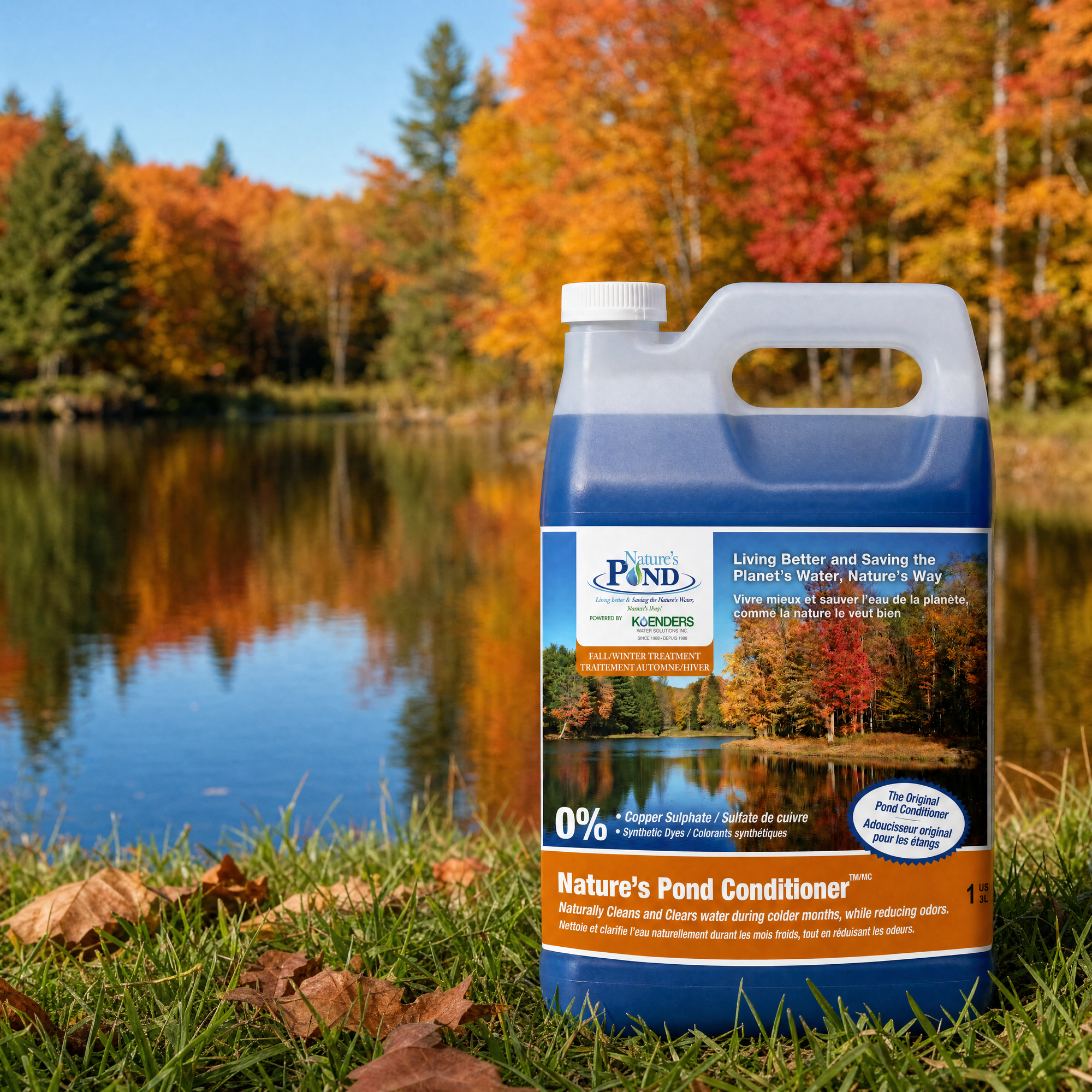
Aeration keeps the water aerobic, but the nutrients still need somewhere to go. This is where beneficial biology earns its place. Nature's Pond Conditioner beneficial bacteria is an all-natural blend of aerobic and anaerobic bacteria, enzymes, and plant extracts that digests the organic waste on the bottom and competes with algae for the phosphorus and nitrogen it feeds on. It is non-pathogenic and safe for fish, pets, livestock, and wildlife when used as directed. Pairing aeration with beneficial bacteria is the whole idea behind the Renew, Revive, Remove program: condition the water, aerate it, and remove built-up muck and vegetation so the nutrient bank that fuels blooms keeps shrinking.
One honest caveat: this is a prevention strategy, not an emergency treatment. Beneficial bacteria and aeration make blooms far less likely over a season by starving them of nutrients and low-oxygen conditions. They are not a way to detoxify water that is already blooming. If you have an active toxic bloom, the priority is denying access and calling your vet, not dosing the pond.
Reduce the nutrient load coming in
Prevention also happens on the land around the water. Fencing cattle out of the pond and watering them from a trough off the pond keeps manure out of the water and cuts the nutrient supply directly. Managing runoff, keeping fertilizer and feed away from the shoreline, and buffering the banks with vegetation all reduce the fuel a bloom needs. Watering from a clean off-take instead of the pond itself protects both water quality and the animals, an approach we cover further in stock tank and pond care.
A late-summer monitoring routine
Because blooms strike hardest in hot, calm weather, build a simple habit from July through early fall:
- Walk the downwind shore of every waterbody your animals can reach, a couple of times a week in hot spells. That leeward edge is where a bloom concentrates first.
- Watch the weather. A stretch of hot, still, sunny days after a rain that flushed in nutrients is prime bloom weather. Step up checks then.
- Know your baseline. If you know what your water normally looks like, a sudden paint-like or pea-soup change stands out immediately.
- Have a backup water plan ready so you can move animals or haul water the same day you spot a suspect bloom.
- Test if unsure. A lab test is the only way to confirm toxicity, so line up your extension or lab contact before you need it.
Toxicity is one of several reasons to test dugout and pond water for livestock. Dissolved salts like sulfate and high total dissolved solids matter too, and we walk through the numbers and when to test in is your pond water safe for cattle.
The bottom line
Blue-green algae is the one water problem on a cattle operation where waiting can be fatal. Learn the paint-like, pea-soup look, deny access the moment you suspect it, and call your vet fast. Then take away the conditions blooms need: keep the water aerated and circulating, draw down the nutrients with beneficial bacteria, and keep manure and runoff out of the water. If you would like help setting up prevention for your ponds and dugouts, our in-house pond experts will give you a free recommendation. Get in touch with our team and we will help you build a plan that keeps your water clean and your herd safe.
Related
- Dugout water treatment for cattle Fix black, smelly dugout water at the source
- Clean livestock water guide Treat tanks, troughs, and dugouts without chemicals
- Is your pond water safe for cattle? Sulfate, nitrate, and TDS thresholds and testing
- Windmill aeration for dugouts Off-grid circulation with no power line
- Nature's Pond Conditioner Beneficial bacteria for nutrient control
- The 3-step Pond Care Program Renew, Revive, Remove for lasting clean water
FAQ