 Canada
 United States
Diagnostic guide
Is Your Pond or Dugout Water Safe for Cattle? Nitrates, Sulphates, TDS, and When to Test
Pond and dugout water is usually safe for cattle if the dissolved salts test within extension thresholds. Here are the numbers that matter and when to test.
Last updated August 31, 2026
Pond or dugout water is usually safe for cattle if dissolved salts are within extension thresholds. Common guidelines put sulfate under about 1,000 ppm for adult cattle and under 500 ppm for calves, with total dissolved solids caution above 3,000 ppm and avoidance above 5,000 ppm. Toxic blue-green algae is a separate, acute danger. Test to confirm.
Every summer the same worry comes up on the acreage: the dugout looks green, the pond has a whiff to it, and the herd is drinking from it every day. Is that water actually safe for your cattle, or is it quietly costing you intake, gain, and in the worst case an animal? The honest answer is that pond and dugout water is usually safe for cattle, but usually is not good enough when you have livestock on it. The only way to know for sure is to look at a short list of numbers and, when in doubt, test.
This guide walks through the water-quality thresholds that matter most for beef cattle: sulfate, total dissolved solids (TDS), and nitrate, plus the one acute danger that no threshold covers, toxic blue-green algae. Then we cover when to test, how to read the results, and what water treatment can and cannot fix. Throughout, the numbers below are cited from provincial and state extension guidance, not our own lab. Confirm them with your provincial or state lab before you act on them.
The short answer: usually safe, but test the salts
Clean, well-managed pond or dugout water is a normal, accepted water source for cattle across the prairies and rural North America. The problems are rarely the water being "pond water" per se. They come from a handful of measurable things: dissolved salts building up (especially sulfate and overall TDS), nitrate loading, and toxic algae blooms. Two of those, sulfate and TDS, tend to creep up slowly through a dry summer as the waterbody shrinks and concentrates. The third, blue-green algae, can turn deadly in a matter of hours.
So the practical rule is simple. If the dissolved salts test within accepted limits and there is no toxic bloom, the water is generally safe to offer. If you have never tested a source, or if drought has been shrinking it, or if animals are backing off the water, that is your signal to pull a sample. A single lab test on a jar of water tells you where you stand for a whole season.
You cannot see sulfate, TDS, or nitrate. Clear water can still be over the line, and green water can still be within it. Numbers, not looks, decide whether pond water is safe for cattle.
The thresholds that matter
There is no single magic number for "safe cattle water," but extension services publish practical guidelines for the parameters that most often cause trouble. Treat these as decision points, not hard cliffs: performance and palatability decline gradually as levels rise, and calves and lactating cows are more sensitive than dry adult cows. All values below are attributed to extension sources such as NDSU Extension, the University of Missouri Extension, and Manitoba Agriculture.
| Parameter | Guideline value | What it affects | Source basis |
|---|---|---|---|
| Sulfate, adult cattle | under ~1,000 ppm | Intake, copper status, polio risk at high levels | NDSU / Manitoba Ag |
| Sulfate, calves | under ~500 ppm | Same, with greater sensitivity in young animals | NDSU / Manitoba Ag |
| Total dissolved solids (TDS), caution | above ~3,000 ppm | Palatability and performance begin to decline | NDSU / Missouri Ext. |
| Total dissolved solids (TDS), avoid | above ~5,000 ppm | Generally not recommended for cattle | NDSU / Missouri Ext. |
| Nitrate (as nitrate-N) | interpret with total ration | Adds to nitrate from feed; combined load matters | NDSU / Missouri Ext. |
| Blue-green algae (cyanobacteria) | no safe visible level | Acute, potentially fatal poisoning | UNL / K-State Ext. |
Sulfate (the usual prairie culprit)
Sulfate is the most common water-quality problem in prairie dugouts and stock ponds, and it is the one that sneaks up during a dry year. Extension guidance commonly cites keeping sulfate under about 1,000 ppm for adult cattle and under about 500 ppm for calves. High sulfate cuts water intake because it tastes bitter, it interferes with copper absorption, and at high enough levels it is linked to polioencephalomalacia (a brain disorder sometimes called "sulfate polio"). Because it concentrates as a waterbody evaporates, a dugout that tested fine in spring can drift over the line by August.
Total dissolved solids (TDS)
TDS is the sum of all dissolved salts in the water, and it is a good overall health-of-the-water number. Extension guidance generally treats water up to roughly 3,000 ppm TDS as usable with caution, with palatability and performance declining as it climbs, and water above about 5,000 ppm as something to avoid for cattle. Lactating cows, calves, and animals under heat stress are the first to show reduced intake. If your TDS is high, the sulfate number usually explains a big share of it.
Nitrate
Nitrate in water is best interpreted alongside the nitrate in the feed, because the two add together. Water that would be fine on its own can push an animal over the edge when the ration is also high in nitrate (for example, certain stressed forages and cereal greenfeed). Ask the lab to report nitrate as nitrate-nitrogen and interpret it with your feed, rather than reading the water number in isolation.
Blue-green algae: a separate, acute danger
No dissolved-salt threshold protects against toxic algae. Blue-green algae (cyanobacteria) can produce toxins that are lethal to cattle, and the timeline is frightening. According to University of Nebraska extension, poisoning signs can appear within about 20 minutes of drinking and death can follow within 2 to 24 hours, with no antidote. A toxic bloom usually looks like spilled paint, thick pea soup, or a scum blown onto the downwind shore. You cannot confirm toxicity by sight, so treat any heavy scum as dangerous, fence animals off immediately, and call your veterinarian. We cover identification and prevention in depth in our guide to spotting toxic blue-green algae.
When to test your livestock water
You do not need to test every waterbody every month. You do need to test at the moments when the risk changes. A jar of water and a lab fee is cheap insurance against a summer of poor gain or a dead animal.
- Before you rely on a new source. Any new dugout, pond, or well should be tested before cattle depend on it for a season.
- After a drought concentrates the salts. Dry weather shrinks a dugout and pushes sulfate and TDS up; retest mid to late summer if it has been dry.
- When animals go off water or lose condition. If cattle are backing off a source, drinking less, or performing poorly with no other explanation, the water is a prime suspect.
- Ahead of the high-risk season. Late-summer testing flags concentrating salts and rising bloom risk before they cost you.
- After heavy runoff or a manure event. A slug of nutrients or contamination can change both the salt load and the bloom risk.
How to test (what to ask the lab for)
Testing livestock water is straightforward. Collect a clean sample from where the animals actually drink, keep it cool, and get it to an accredited lab quickly. Ask specifically for a livestock suitability panel rather than a drinking-water (human) panel, because the parameters and thresholds are different. At minimum you want sulfate, total dissolved solids, and nitrate-nitrogen. Your provincial or state agriculture lab or extension office can tell you the right container, hold time, and how to interpret the report for your class of cattle. If you already have a lab report and want a second read on what the results mean for your management, our pond experts are happy to talk it through as part of a free water-care review.
The test-then-treat decision path
Once you have numbers, the decision tree is clear. This is where a lot of producers go wrong, because the fix depends entirely on what is out of range.
| Result | What it means | Next step |
|---|---|---|
| Salts within limits, no bloom | Water is generally safe to offer | Manage for palatability: aerate, keep it clean |
| Green or smelly, salts within limits | A nuisance / palatability problem, not a salt problem | Treat the cause: aeration + beneficial bacteria |
| High sulfate or TDS | A dissolved-salt problem treatment cannot remove | Blend, find an alternate source, or offtake elsewhere |
| Thick paint-like scum present | Possible toxic bloom, acute danger | Fence off now, call your vet, do not offer the water |
The two middle rows are where the biggest opportunity lives. Water that is unpalatable from algae, muck, and rotten-egg odor but chemically within limits is not "unsafe," it is underperforming. Cattle drink less of it, and lower water intake drags down feed intake and gain. Cleaning that water up is one of the cheapest ways to protect performance, and it is exactly what a biological plus aeration program is built to do. For a step-by-step on the dugout side, see our guide to treating dugout water for cattle.
What treatment can (and cannot) fix
This is the most important honesty in the whole guide, and it is where a lot of marketing gets it wrong. Aeration and beneficial bacteria are excellent at some things and completely useless at others. Knowing the difference keeps you from wasting money and from a false sense of safety.
What aeration and beneficial bacteria DO fix
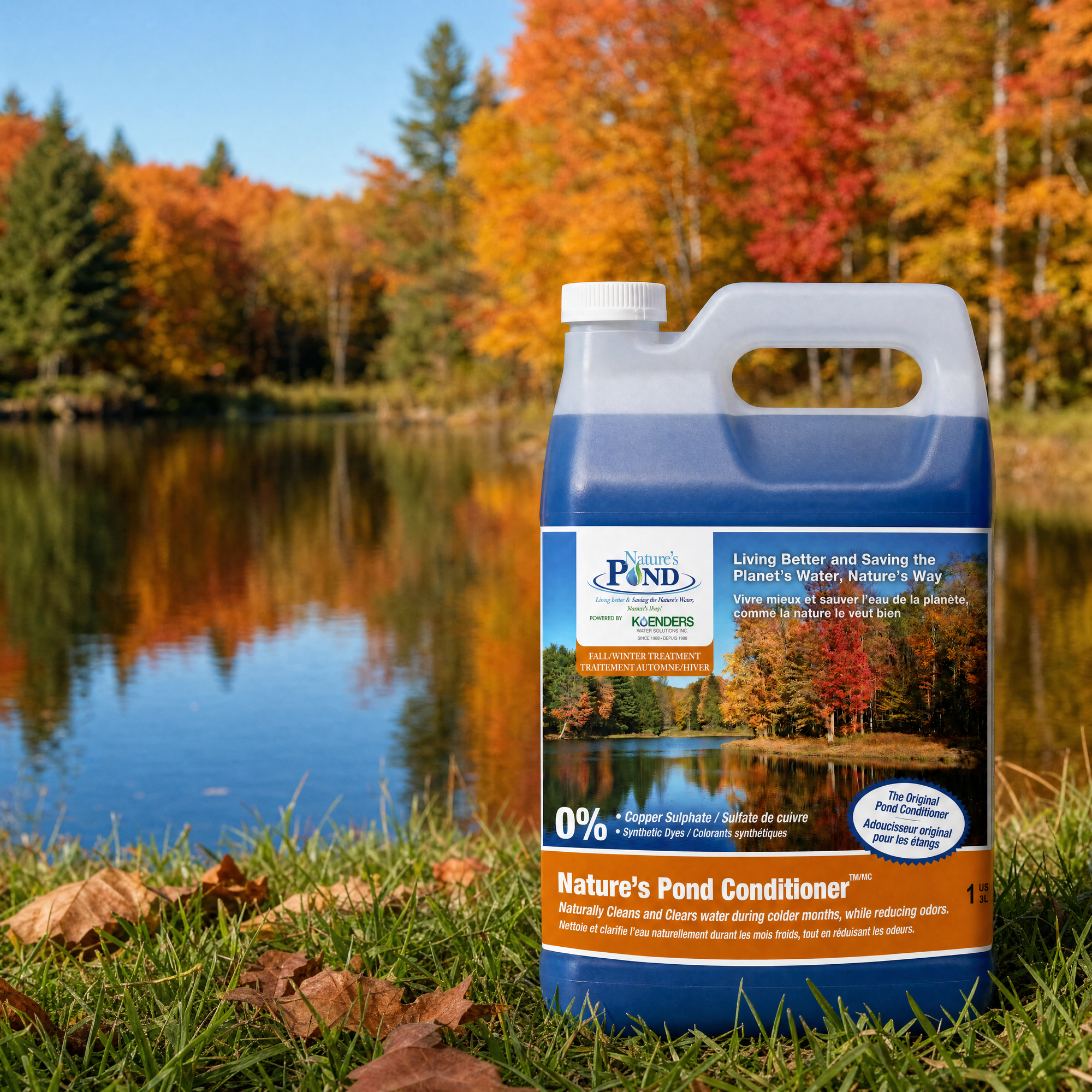
Continuous bottom aeration keeps a dugout oxygenated and aerobic, which stops the water from going black and producing hydrogen sulfide, the source of that rotten-egg smell. Adding oxygen at the sediment also lets aerobic beneficial bacteria digest the organic muck and consume the excess nutrients that feed algae. Nature's Pond Conditioner is an all-natural blend of aerobic and anaerobic beneficial bacteria, enzymes, and plant extracts with a food-grade dye. It is non-pathogenic and safe for fish, pets, livestock, and wildlife when used as directed, and it works by converting organics to carbon dioxide and water rather than by killing anything. Paired with aeration, that combination improves odor, clarity, algae pressure, and palatability, which is what actually drives cattle to drink more.
- Removes the rotten-egg odor by keeping the water aerobic
- Digests organic muck and the nutrients that feed algae with fish- and livestock-safe beneficial bacteria
- Improves palatability so cattle drink more, supporting intake and gain
- Runs off-grid on a remote dugout with windmill aeration, no power line required
What treatment does NOT fix
Aeration and beneficial bacteria do not remove dissolved salts. They do not lower sulfate, they do not lower TDS, and they do not lower nitrate. Those are dissolved in the water, and biology and bubbles cannot take them out. If your test comes back with sulfate or TDS over the guideline, no pond product on the market fixes that. Your real options are blending with a lower-salt source, developing a different water source, or piping the drinking offtake somewhere better. Anyone who tells you a bacteria or aeration product will "lower your sulfate" is selling you the wrong thing. Treatment makes safe-but-ugly water clean and drinkable; it cannot make chemically unsafe water safe.
Treatment turns unpalatable water into water cattle want to drink. It does not turn high-salt water into low-salt water. Test first so you know which problem you actually have.
Putting it together on your operation
For most prairie producers, the path is: pull a sample from each drinking source, ask the lab for a livestock panel (sulfate, TDS, nitrate-nitrogen), and read the result against the thresholds above. If the salts are within limits and the only issue is green, mucky, or smelly water, you have a palatability problem you can fix at the source with aeration and beneficial bacteria, and cleaner water tends to mean more intake and better performance. If the salts are over the line, you have a sourcing problem no additive solves. And regardless of the salts, keep an eye out through late summer for the paint-like scum of a toxic bloom, because that danger runs on its own clock.
If you would like a hand reading a lab report or building a treatment plan for a specific dugout or pond, our in-house pond experts will review your situation and give you a free, no-obligation recommendation. Get in touch with our team, or start with the clean livestock water guide for the full stock-tank, trough, and dugout playbook.
Related
- Dugout water treatment for cattle Fix black water, smell, and algae at the source
- Blue-green algae and cattle Spot a toxic bloom before it kills your herd
- Clean livestock water guide Tanks, troughs, and dugouts without harsh chemicals
- The 3-step Pond Care Program Renew, Revive, Remove for cleaner water
- Off-grid windmill aeration Aerate a remote dugout with no power line
- Talk to our pond experts Free water-care review and recommendation
FAQ