 Canada
 United States
Sector guide
Dugout Water Treatment for Cattle: Aeration, Filtration, and Getting Rid of the Rotten-Egg Smell
Fix a black, smelly, or algae-choked cattle dugout at the source with continuous bottom aeration and beneficial bacteria, off-grid where there is no power line.
Last updated August 31, 2026
To treat dugout water for cattle, run continuous bottom-diffused aeration so the water stays aerobic and stops going black and smelly, then add beneficial bacteria to digest muck. Where there is no power line, a windmill or solar aerator does the job off-grid. Filtration at the off-take further protects the animals' drinking source.
A cattle dugout is supposed to be the easy part of your water plan: dig it, fill it with runoff, and let the herd drink. Then mid-summer arrives, the surface turns pea-green, the water goes dark, and a whiff of rotten eggs rises off the bank. Animals start hanging back from the edge. None of that is bad luck. It is a predictable chain reaction you can reverse by treating the cause instead of dumping another jug of chemical into the water.
This guide walks through dugout water treatment for cattle the way we would set it up on a working prairie operation: aeration first, then biology, then filtration and mechanical cleanup. It is the same root-cause thinking behind the Renew, Revive, Remove program, scaled to an earthen dugout with no power line in sight.
Why dugouts go black and smell like rotten eggs
A dugout is deep and still. On a hot, calm stretch the water separates into layers: warm, lighter water floats on top of cold, dense water at the bottom. That bottom layer gets cut off from the air, and the oxygen down there gets used up faster than anything can replace it. Once the bottom goes oxygen-starved, it turns anaerobic, and a different set of bacteria takes over.
Those sulfate-reducing bacteria produce hydrogen sulfide, the gas behind that unmistakable rotten-egg odor. The same low-oxygen bottom lets organic muck pile up instead of breaking down, and the dark, septic water you see is the visible result. If you want the full mechanism, we cover why water smells like rotten eggs in detail, but the short version is simple: the smell is a symptom of missing oxygen, not a smell problem you can mask.
Black, smelly dugout water is oxygen-starved water. Put oxygen back in, and the chemistry that makes the smell reverses on its own.
This is also why the cheap habit backfires. Copper sulfate knocks down a visible bloom, but the dead algae sinks to that same starved bottom, rots, and releases the nutrients that feed the next bloom. You end up dosing again and again while the underlying problem gets worse.
Step 1: Continuous bottom aeration (the core fix)
Aeration is the single change that fixes the most. By pushing air to the bottom of the dugout, you break up the layers, circulate the whole water column, and keep the sediment interface aerobic. The rotten-egg gas stops forming, muck starts breaking down instead of building up, and the water clears as the septic condition reverses. Prairie producers commonly report black water clearing within days of starting aeration, though your timeline depends on depth, muck load, and water temperature.
The key phrase is bottom-diffused. A surface splasher or fountain only touches the top layer and does little for the deep, starved water where the trouble lives. A diffuser sitting near the bottom lifts a column of water and air from the deepest point, which is exactly where a dugout needs it.
Off-grid options where there is no power line
Most pasture dugouts sit nowhere near a power line, and that is where the Koenders heritage matters. A windmill aerator runs on wind alone: the wind drives an air compressor that pushes air down to a bottom diffuser, with no power line, no batteries, and no fuel. Koenders has been building windmill aerators since 1988, and off-grid dugout aeration is the problem the product was designed around.
- Windmill aeration: best where the site gets reliable, open wind. No ongoing energy cost, nothing to plug in. See off-grid windmill dugout aeration.
- Solar aeration: a strong fit for sunny, sheltered, low-wind sites. It runs when the sun is on the panels, and battery backup extends run time into the night. See solar dugout aeration.
- Electric aeration: simplest and steadiest, but only realistic where a power line already reaches the water.
If you are weighing which power source fits your site and budget, we break the whole decision down in windmill vs solar vs electric for dugouts. Rural and off-grid setups are exactly what off-grid pond and dugout care is built for.
Diffuser placement and depth
Set the diffuser at or near the deepest point so the rising column pulls from the worst of the starved water. Give it a stable base so it does not sink into soft muck and clog. In a very deep dugout you may want more than one diffuser to keep the whole basin turning over. Sizing depends on surface area, depth, and shape, which is exactly the kind of thing worth getting right the first time. Rather than guess, tell us your dugout dimensions and our pond experts will size it for you for free.
Step 2: Beneficial bacteria to digest the muck
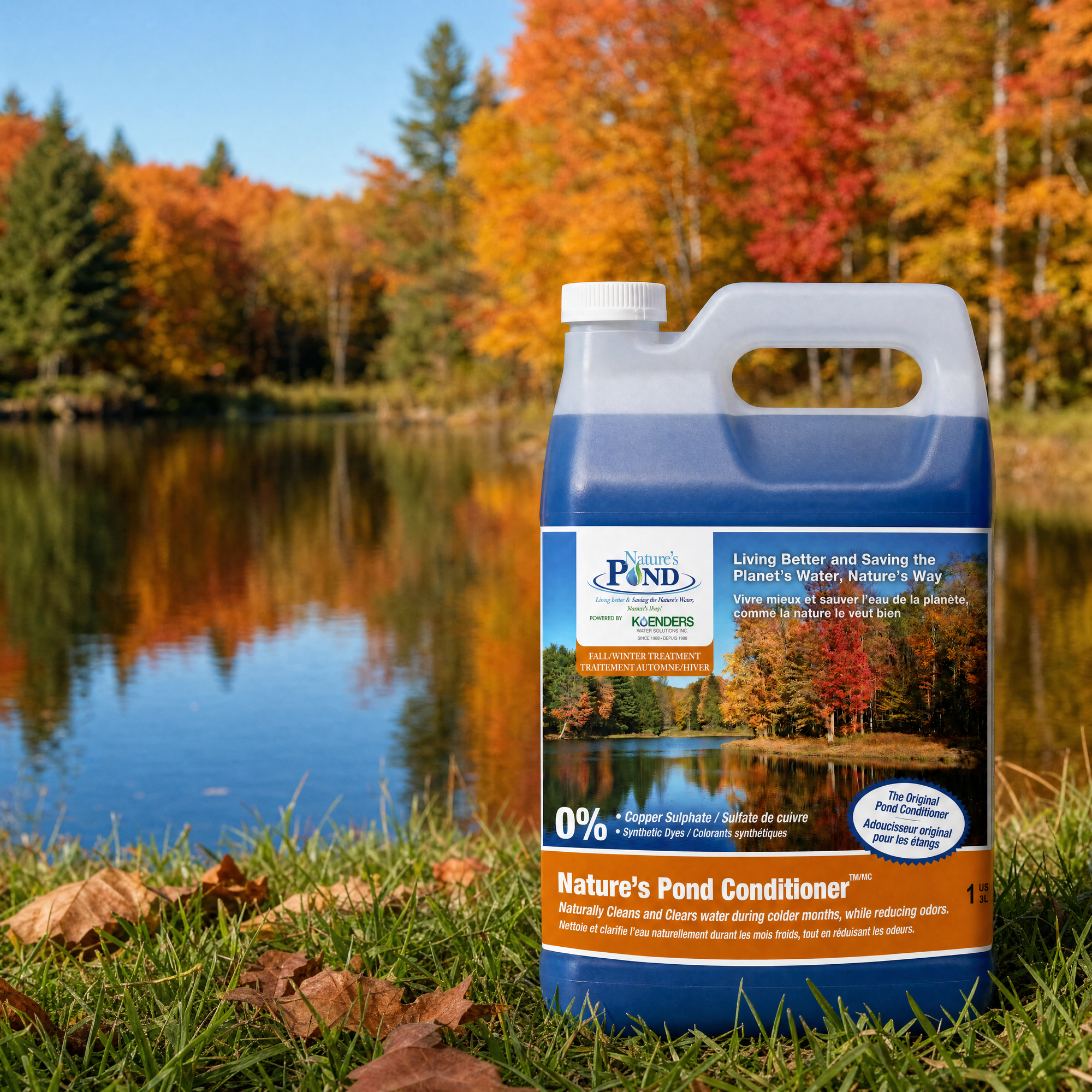
Aeration sets the table; beneficial bacteria eat the meal. Nature's Pond Conditioner is an all-natural blend of aerobic and anaerobic beneficial bacteria, enzymes, and plant extracts. It works by digesting the organic muck and excess nutrients on the bottom, converting them to carbon dioxide and water. Fewer nutrients in the water means less fuel for algae and a thinner muck layer over time.
The two steps are a pair, not a choice. The bacteria that break down muck fastest are aerobic, so they need the dissolved oxygen your aerator provides, and aeration alone still leaves the nutrient load behind. Run them together and each one makes the other work better. The Conditioner is non-pathogenic and safe for fish, pets, livestock, and wildlife when used as directed, which is the whole point for a water source your herd drinks from every day.
Step 3: Filtration and off-take for the drinking source
Aeration and biology clean up the dugout itself. To protect what the animals actually drink, add a remote watering setup that pulls from the dugout and delivers to a trough away from the bank. Drawing water from below the surface, rather than off the top scum layer, gives cleaner, cooler, more palatable water and keeps cattle out of the mud.
A simple intake screen or filter on the off-take line keeps weeds, silt, and debris out of the trough. Cleaner trough water is not just tidier: cattle drink more of it, and higher water intake supports feed intake. The evidence and the payback math on that live over on does clean water really fatten cattle.
Step 4: Mechanical removal of heavy vegetation
Aeration and bacteria digest the soft organic muck, but they do not do anything for a dense mat of cattails, bulrush, or heavy weed growth choking the edges. For that, mechanical removal is the honest answer: cut and rake out the heavy vegetation so it is not sitting there rotting and re-loading the water with nutrients. Do the heavy pull once, then let aeration and biology hold the line so it does not come roaring back.
| Step | What it fixes | Powered or off-grid | Ongoing effort |
|---|---|---|---|
| Bottom aeration | Rotten-egg smell, black water, stratification | Windmill or solar off-grid, or electric | Very low once running |
| Beneficial bacteria | Organic muck and excess nutrients | Works with either power source | Periodic dosing in the warm season |
| Filtration / off-take | Debris and scum in the drinking water | Gravity or low-power intake | Occasional screen cleaning |
| Mechanical removal | Heavy weeds, cattails, dense mats | Manual (rake or cutter) | Once, then spot maintenance |
Winter aeration on the prairie
Prairie winters do not switch the problem off. Under a lid of ice, a dugout can still go oxygen-starved and turn on the herd's water source, and continuous aeration through winter keeps a hole open and the water aerobic. A windmill can run through the cold season because it needs wind, not a thaw. The trick in hard-freeze country is to ease back the airflow and set the diffuser a little shallower so you keep an open hole without over-mixing and super-cooling the whole dugout. If you are running an off-grid system through a prairie winter, ask us how to set it for your climate.
A realistic timeline: black to clear
Nobody wants vague promises about their water, so here is the honest shape of it. The smell is usually the first thing to go, often within days of steady aeration, because the gas stops forming as soon as oxygen returns to the bottom. Water clarity follows as circulation takes hold and the bacteria get to work. Muck reduction is the slow one: it is a season-over-season process, not an overnight fix, because you are digesting a layer that took years to build.
- Days: the rotten-egg odor fades as aeration restores oxygen and the gas stops forming.
- Weeks: the water circulates, stratification breaks, and clarity improves as the septic bottom recovers.
- Season over season: the organic muck layer thins as beneficial bacteria digest it, especially through warm water.
The reward for treating the cause is that it compounds. Every season the muck load gets a little lighter and the water gets a little easier to keep clear, which is the opposite of the chemical treadmill where the problem comes back worse each year.
Put it together as a program
Aeration, biology, filtration, and mechanical cleanup are not four separate errands. They are one program: keep the water oxygenated, let the bacteria digest what is already there, protect the drinking off-take, and pull the heavy weeds once. That is the same Renew, Revive, Remove approach we teach for any waterbody, tuned for an earthen dugout your cattle depend on.
If you would rather not piece it together yourself, tell us your dugout size, depth, and whether you have power at the site, and our pond experts will build you a free plan and sizing estimate.
Related
- Clean livestock water guide The full tanks, troughs and dugouts hub
- Windmill vs solar vs electric for dugouts Off-grid aeration cost comparison
- Off-grid windmill aeration Wind-powered dugout aerators
- Off-grid pond and dugout care Solutions for remote, no-power sites
- Why water smells like rotten eggs The hydrogen sulfide mechanism explained
- Is your water safe for cattle? Sulfate, nitrate and TDS thresholds
FAQ