 Canada
 United States
Aeration guide
Why Aeration Is the Missing Half of Muck Removal (Oxygen + Bacteria Done Right)
Aeration reduces pond muck by getting oxygen to the bottom so bacteria can digest the organic layer. Here is how it works, and why bottom-diffused beats a fountain.
Last updated August 31, 2026
Aeration reduces pond muck by delivering oxygen to the bottom, where it supports aerobic breakdown of the organic layer and helps beneficial bacteria work. Bottom-diffused aeration outperforms surface aeration for muck because it circulates and oxygenates the whole water column from the sediment up. Start aeration slowly to avoid triggering a turnover that can stress fish.
If your pond bottom is soft, dark, and gives off a rotten-egg smell when disturbed, you have an organic muck layer that is decomposing without enough oxygen. Many owners reach for a bag of bacteria pellets and wait for results that never quite come. The reason is almost always the same: the bacteria that digest muck are aerobic, and the very bottom of a mucky pond is where oxygen runs out first. Aeration is the half of the equation most people skip, and it is what makes the biology actually work.
This guide explains how aeration reduces muck, why bottom-diffused aeration outperforms a surface fountain for the job, whether you still need beneficial bacteria if you aerate (you do), and how to add aeration slowly so you do not trigger a dangerous turnover. It pairs with the biology-first side of our full pond aeration guide and the honest, evidence-based look at whether bacteria alone can remove muck.
How aeration reduces pond muck
Pond muck is mostly organic matter: dead leaves, algae die-off, fish waste, uneaten feed, and runoff that has settled and started to break down. That breakdown consumes oxygen. In a still pond, the deepest water and the sediment surface become oxygen-starved, which is exactly where the muck sits. Without oxygen, decomposition shifts to slow anaerobic processes that release hydrogen sulfide, the source of the rotten-egg smell and black bottom.
Aeration changes the chemistry at the sediment interface. By pushing air to the bottom, it raises dissolved oxygen right where the organic layer is decomposing. Aerobic breakdown is faster and cleaner than the anaerobic process it replaces: it converts organic material toward carbon dioxide and water instead of stalling out into sulfide and sludge. The oxygen also lets aerobic beneficial bacteria populate the sediment surface and work at full speed.
There is a second effect that matters just as much. Aeration circulates the whole water column, breaking up the temperature layers that trap oxygen-poor water at the bottom. A mixed, oxygenated pond keeps the bottom aerobic all season instead of letting it turn septic between rain events. That circulation is why aeration is prevention as much as it is cleanup: it stops new muck from forming as fast as the old muck is digested.
Aeration does not scrape muck off the bottom. It changes the conditions so the organic layer can be digested instead of piling up.
Why bottom-diffused aeration beats a surface fountain for muck
Not all aeration reaches the muck. A decorative surface fountain sprays water into the air and oxygenates the top few feet, which looks great and can help a shallow ornamental pond. But muck lives on the bottom, and a fountain does little for it in a deep pond because it never delivers oxygen to the sediment.
Bottom-diffused aeration works from the sediment up. An air compressor on shore pushes air through a weighted line to one or more diffusers sitting on the pond bottom. The rising column of fine bubbles lifts cold, oxygen-poor bottom water toward the surface, where it releases gases and picks up oxygen, then the whole column keeps turning over. This is why bottom-up diffused aeration is the better choice for destratification and for muck: it targets the exact layer where the problem lives.
| Type | Where it oxygenates | Effect on bottom muck | Best use |
|---|---|---|---|
| Bottom-diffused aeration | The whole water column, from the sediment up | Directly oxygenates the muck layer so aerobic breakdown and bacteria can work | Deeper ponds, muck reduction, destratification |
| Surface fountain or aerator | The top few feet of water only | Little effect on a deep muck layer; mostly aesthetic and surface oxygen | Shallow ornamental ponds, visual appeal |
You can browse bottom-up systems under windmill aeration and solar aeration. If a power line is the problem, the same bottom-up approach works off-grid, which we cover below.
Do you still need bacteria if you aerate? Yes, together
Aeration and beneficial bacteria are not competing options. They are two halves of the same job. Aeration supplies the oxygen; the bacteria do the digesting. Oxygen without a healthy bacterial population breaks organics down more slowly, and bacteria without oxygen at the sediment simply cannot keep up with the muck they are asked to eat.
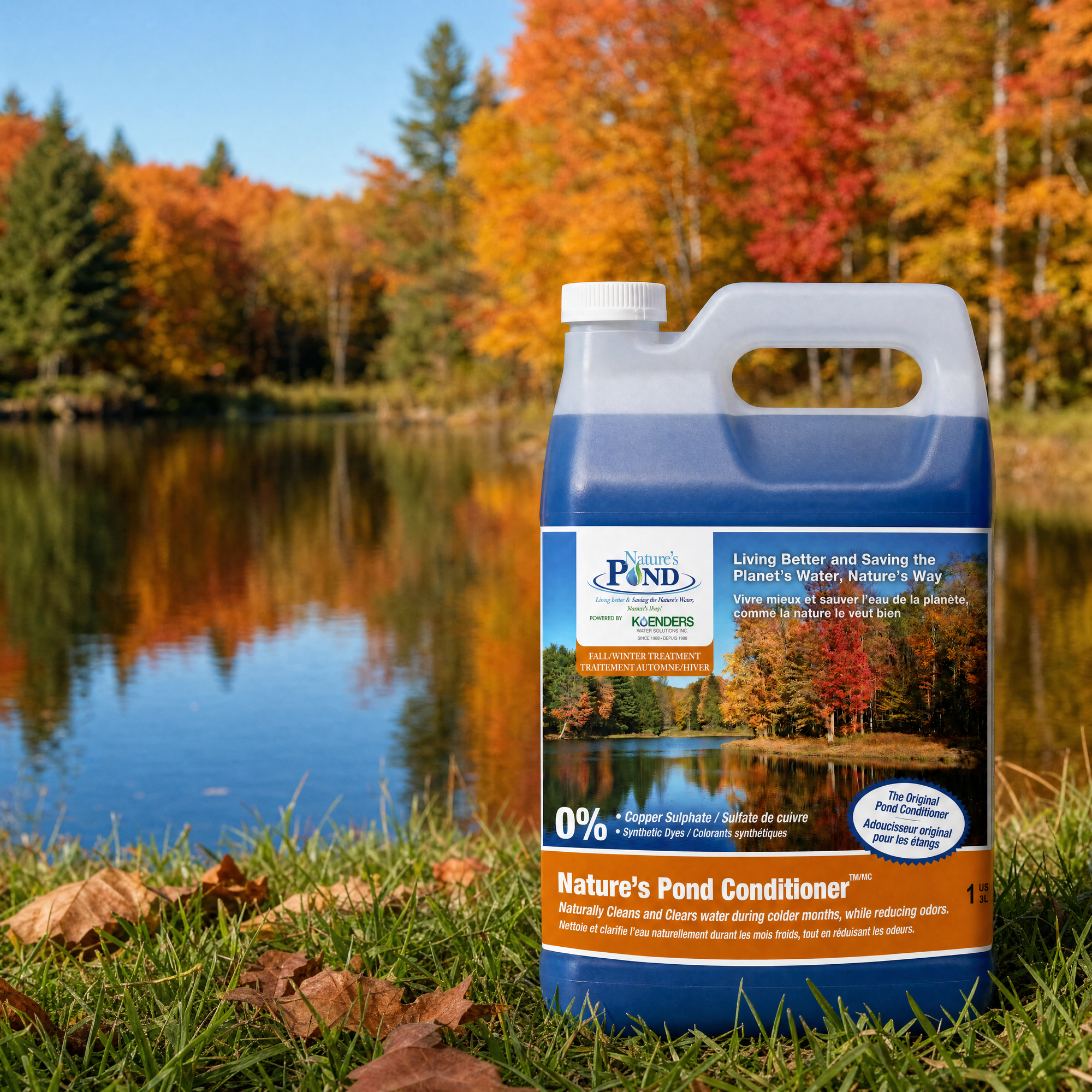
That is why the 3-step Pond Care Program pairs them deliberately. You Renew by conditioning the water with Nature's Pond Conditioner, an all-natural blend of aerobic and anaerobic beneficial bacteria, enzymes, and plant extracts that is safe for fish, pets, livestock, and wildlife when used as directed. You Revive by oxygenating the bottom with aeration so those aerobic bacteria can thrive. You Remove what biology cannot digest, using light mechanical cleanup for the surface and edges. For a deeper look at how the biology behaves, see does beneficial bacteria really remove pond muck.
One honest limit worth stating plainly: bacteria digest the organic portion of muck only. Silt, sand, and clay are inorganic, and no amount of bacteria or oxygen will remove them. If a survey shows your bottom layer is mostly mineral sediment rather than soft organic muck, biological treatment will not shift it, and mechanical removal is the tool for that job.
How fast does aeration reduce muck?
This is the question every owner wants pinned to a number, and an honest answer resists one. Muck reduction is gradual, and the pace depends on how much organic muck you have, water temperature, how much runoff and leaf litter keeps feeding the pond, and how well the whole bottom is oxygenated. Bacteria slow down in cold water and speed up as the pond warms, so most of the visible progress happens across the warm months, not in a single week.
We will not publish an inch-per-season figure, because the real rate varies too much from pond to pond to state as fact. What we can promise is direction: with oxygen at the bottom and a consistent conditioning program, the organic layer shrinks over weeks and months rather than overnight, and the pond stops adding new muck as fast as it once did. If you want a realistic expectation for your specific pond, our pond experts can review it and give you a free estimate.
The honest expectation is steady reduction of the organic layer over a season, not a dramatic overnight change.
Where to place a bottom diffuser
Diffuser placement decides how much of the pond actually benefits. As a general rule, a diffuser goes at or near the deepest point, so the rising column lifts and circulates the entire water body from the bottom up. In a small, round pond a single centred diffuser often covers the whole surface. Longer, irregular, or larger ponds usually need more than one diffuser to avoid leaving dead zones where the bottom stays still and oxygen-poor.
- Set the diffuser at or near the deepest area so it turns over the full column.
- In small round ponds, a single centred diffuser is often enough.
- In long, irregular, or large ponds, use multiple diffusers to reach every low spot.
- Keep the compressor and airline sized to the depth and distance so airflow does not fall off.
Sizing the compressor, the number of diffusers, and their layout to your pond is where guesswork costs money. Rather than an on-site calculator, we do this by hand: tell us your surface acres, average depth, and shape, and our team will size a system and give you a free estimate.
Slow-start: adding aeration without triggering a turnover
Here is the single most important safety point on this page. If your pond already has a thick, black, anaerobic bottom layer, switching on full aeration all at once can force that oxygen-poor, sulfide-rich water up through the whole pond in a rush. The result is a sudden crash in dissolved oxygen, the same event that kills fish during a natural fall turnover. You can cause the very problem you are trying to prevent.
The fix is to start slowly. On a pond with an established muck layer, run aeration for short periods at first and increase the run time gradually over a couple of weeks, letting the bottom oxygenate in stages rather than in one violent mix. Starting in cooler weather, when the water holds more oxygen and biological demand is lower, is gentler still. If you are unsure how aggressive to be on a heavily loaded pond, ask before you commit.
- Run aeration for short periods at first, not continuously.
- Increase the daily run time gradually over about two weeks.
- Prefer starting in cooler weather when the water holds more oxygen.
- Watch for fish gasping at the surface and ease back if you see it.
Off-grid ponds: windmill and solar aeration with no power line
Plenty of the ponds that need aeration most are the farthest from a power line: back-forty dugouts, acreage ponds, and remote water on off-grid properties. Running electrical service to a distant pond is often more expensive than the aeration system itself, which is why so many rural owners assume aeration is out of reach. It is not.
Off-grid windmill aeration uses the wind to drive an air compressor that feeds the same kind of bottom diffuser, with no power line and no electricity bill. Where a site is sunny but calm, solar aeration runs a compressor from panels and batteries instead. Both deliver the bottom-up oxygen that muck reduction depends on, which lets remote and prairie ponds run the same biology-plus-aeration program as any pond on the grid.
Putting it together
Muck is a symptom of a pond that has more organic matter settling than its bottom can digest, and the bottom cannot digest it because it has run out of oxygen. Aeration fixes the oxygen. Beneficial bacteria do the digesting. Light mechanical cleanup handles the surface, edges, and anything inorganic. Run all three together and you treat the cause instead of chasing the symptom every summer.
When you are ready, start with the 3-step Pond Care Program, shop off-grid windmill aeration or solar aeration for your site, and if you want a system sized to your pond, contact our pond experts for a free estimate.
Related
- The 3-step Pond Care Program Renew, Revive, Remove for lasting muck control
- Does beneficial bacteria remove pond muck? The honest, evidence-based answer
- Pond aeration guide: benefits, types, sizing How aeration works and which type fits
- Why your pond smells like rotten eggs Hydrogen sulfide and the black bottom explained
- Nature's Pond Conditioner Beneficial bacteria that digest organic muck
- Off-grid windmill aeration Wind-powered aeration with no power line
FAQ