 Canada
 United States
Natural care
Does Beneficial Bacteria Really Remove Pond Muck? An Honest, Evidence-Based Answer
Beneficial bacteria can digest the organic layer of pond muck, but only with oxygen at the bottom and warm water. Here is the honest, evidence-based answer.
Last updated August 31, 2026
Beneficial bacteria can reduce the organic portion of pond muck, but only when dissolved oxygen reaches the sediment and the water is warm enough for the bacteria to work. University extension sources note limited proof that additives alone decompose muck. Bacteria never touch silt, sand or clay, so pair a conditioner with bottom-up aeration for real results.
If you have watched a soft, black, foul-smelling layer build up on your pond bottom, you have probably wondered whether those bacteria pellets and liquids actually do anything, or whether they are just expensive pond dust. It is a fair question, and most sellers answer it with confidence and very few caveats. We are going to answer it honestly instead, including the parts the label leaves out.
The short version: beneficial bacteria can reduce the organic part of your muck, but only under specific conditions, and never the whole story. Understanding those conditions is the difference between money well spent and a bottle that quietly does nothing.
Bacteria digest organic muck. They do not digest silt, sand or clay. And they only work when there is oxygen at the bottom where the muck sits.
The honest short answer
Pond muck is not one substance. Part of it is organic: decomposed leaves, dead algae, uneaten fish feed, grass clippings, and runoff debris. Part of it is inorganic: silt, sand, and clay washed in from the watershed. Beneficial bacteria and enzymes work on the organic fraction only. They break long-chain organic molecules down into simpler compounds and ultimately into carbon dioxide and water. They have no effect whatsoever on inorganic sediment.
So the accurate answer to "does beneficial bacteria remove pond muck" is: yes for the organic layer, no for silt and clay, and only when oxygen and temperature let the bacteria stay active. If your muck is mostly washed-in mineral sediment, no bottle of bacteria on the market will move it. If it is mostly the soft black organic ooze that smells like rotten eggs, bacteria can genuinely help, provided you give them what they need to work.
What the skeptics get right
There is a healthy dose of skepticism online about pond muck reducers, and some of it is well founded. It is worth taking seriously rather than waving away, because it tells you exactly when these products underperform.
University extension: limited proof that additives alone decompose muck
University of Florida IFAS extension guidance on pond muck (publication FA200) is blunt about it: there is limited scientific evidence that adding commercial bacteria or enzyme products by themselves meaningfully decomposes accumulated bottom muck. Extension sources also point out that most ponds already contain native decomposer bacteria, and that the limiting factor is usually not the number of bacteria but the conditions they are working in. That is the key insight the marketing tends to skip.
The dissolved-oxygen gate at the sediment interface
The bacteria that digest organic muck fastest are aerobic, meaning they need dissolved oxygen to do their work. The problem is that a thick muck layer is exactly where oxygen runs out first. Decomposition consumes oxygen, and once the sediment goes anaerobic (oxygen-starved), the fast aerobic breakdown stops and slow, smelly, sulfide-producing anaerobic processes take over. That is the black bottom and the rotten-egg odor so many pond owners describe. Pour bacteria onto an oxygen-starved bottom and most of them simply cannot function there. This is the single biggest reason a muck reducer "does not work."
Most muck reducers do not fail because the bacteria are bad. They fail because there is no oxygen at the bottom for them to breathe.
What the sellers get right (when bacteria genuinely help)
The skeptics are right that bacteria alone, dumped into a stagnant, low-oxygen pond, often disappoint. But that does not make the products a scam. When conditions are right, beneficial bacteria do real, useful work, and the science behind it is sound.
- They accelerate the organic breakdown already happening. Adding a targeted, active bacterial culture to warm, oxygenated water speeds up digestion of the organic layer compared with leaving the pond to its own devices.
- They compete with algae for nutrients. By consuming dissolved organics and nutrients, an active bacterial population leaves less phosphorus and nitrogen for the next algae bloom. Less muck feeding the water means fewer blooms feeding the muck.
- They help keep the bottom aerobic between clean-outs. A healthy decomposer community, supported by oxygen, keeps the sediment interface from tipping fully anaerobic, which is what keeps the rotten-egg smell and sudden oxygen crashes at bay.
For a deeper look at the chemistry and the nitrogen cycle behind all of this, see what beneficial bacteria do for a pond. The point here is narrower: the biology is real, but it is conditional.
Why your muck reducer might not be working
If you have already tried a bacteria product and seen nothing, the culprit is almost always one of four things. Work through them in order before you conclude the product is useless.
1. No oxygen at the bottom
This is the number one reason, and it is worth repeating. If your pond stratifies in summer, or the bottom is thick with black anaerobic muck, the aerobic bacteria you added cannot survive down there. Fixing oxygen at the sediment is not optional; it is the precondition for everything else. That is why aeration is the missing half of muck removal.
2. Water too cold
Bacterial activity is temperature dependent. As water cools, bacteria slow down, and in cold water they can go nearly dormant. Applying a muck reducer to cold spring or autumn water and expecting fast results sets you up for disappointment. The active season for biological breakdown is the warm months, and dosing should follow the water temperature, not the calendar.
3. Wrong expectation (silt versus organic muck)
If your "muck" is largely silt and clay washed in from the watershed, no biological product will reduce it, because there is nothing organic for the bacteria to eat. This is not a product failure; it is a diagnosis failure. It is why we always recommend you measure your muck and get a sense of what it is made of before you buy anything.
4. Under-dosing or stopping too soon
Bacteria are a living treatment, not a one-and-done chemical. A single half-dose early in the season, then nothing, rarely moves a deep muck layer. Results build over weeks to months of consistent dosing through the warm season, not overnight. Owners who apply a full startup dose and maintain it through summer see far more than those who try one bottle and give up.
How long does it actually take?
Here is where we part ways with the aggressive marketing. You will see confident claims that bacteria digest a fixed number of inches of muck per season. We will not put a number on it, because the honest answer is that it depends on water temperature, how much oxygen reaches the bottom, muck depth, and how much new organic material keeps washing in. The realistic expectation is a gradual reduction of the organic layer over weeks and months, not a dramatic overnight clearing. A product promising a precise, guaranteed muck-per-season figure is telling you something the biology cannot reliably deliver.
How to make bacteria actually work: pair it with aeration
Everything above points to one conclusion: bacteria and oxygen are a package deal. If you take nothing else from this page, take this. The most common upgrade that turns a disappointing muck reducer into a working one is not a stronger bacteria product; it is adding bottom-up aeration.
Bottom-diffused aeration pushes air from the deepest point up through the water column, carrying oxygen down to the sediment interface where the muck actually sits. That oxygen wakes up the aerobic bacteria (both the ones you added and the ones already in your pond) and lets them digest the organic layer instead of stalling out in anaerobic mud. It also circulates the whole water column, prevents the sharp stratification that starves the bottom, and helps stop the pond from going black and smelly in the first place.
| Setup | Oxygen at sediment | Organic muck reduction | Best for |
|---|---|---|---|
| Bacteria only | Only if pond is already well oxygenated | Limited; often stalls on a low-oxygen bottom | Small, shallow, naturally well-mixed ponds |
| Aeration only | Good | Some, from native bacteria; slower without a dosed culture | Owners not ready to dose bacteria yet |
| Bacteria + aeration (recommended) | Good | Strongest and most reliable organic breakdown | Most ponds with a real organic muck layer |
For remote or off-grid ponds with no power line at the shore, you can get the same oxygen benefit from off-grid windmill aeration driven by wind alone, so aeration is not only for ponds near an outlet.
What Nature's Pond Conditioner actually is
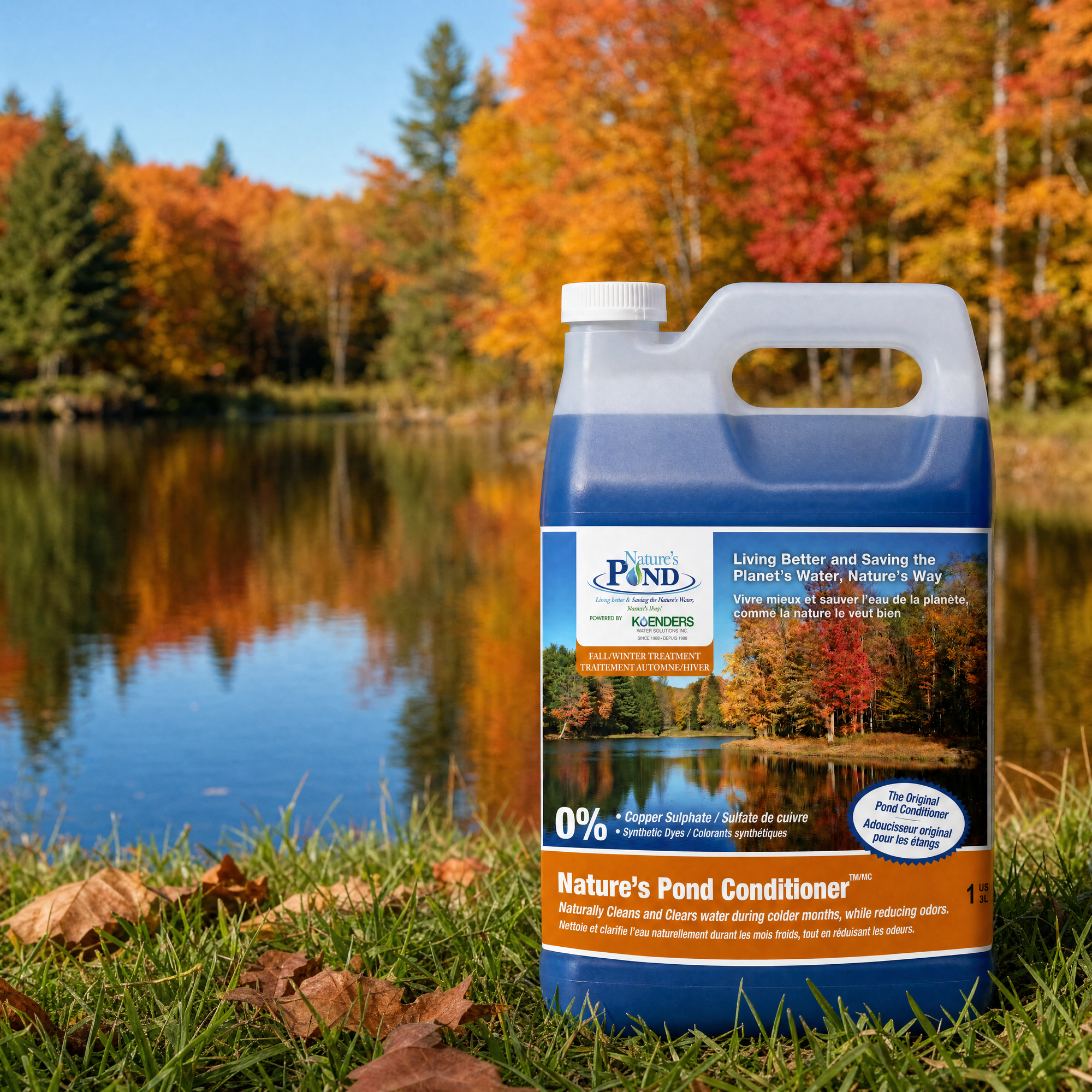
So you know exactly what you are considering: Nature's Pond Conditioner is an all-natural blend of aerobic and anaerobic beneficial bacteria, enzymes, and plant extracts, with a food-grade dye. The bacteria and enzymes digest organic material, converting it to carbon dioxide and water. It is non-pathogenic and is safe for fish, pets, livestock and wildlife when used as directed. It is made in North America.
It is designed to be used the honest way described above: as the biological half of a program that also restores oxygen to the bottom. That is exactly how the 3-step Pond Care Program is built. Renew by conditioning with beneficial bacteria, Revive by aerating from the bottom up, and Remove the surface and edge debris mechanically. Bacteria is one leg of a three-legged stool, not a magic bottle.
The bottom line
Does beneficial bacteria really remove pond muck? Yes, the organic portion, when the water is warm and oxygen reaches the sediment, and no for silt, sand and clay ever. The skeptics are right that bacteria dumped into a stagnant, oxygen-starved pond usually underperform. The sellers are right that the biology genuinely works when conditions allow. The way to be on the winning side of that is to stop treating bacteria as a stand-alone fix and start treating oxygen as its non-negotiable partner.
If you are not sure what your muck is made of, or how much oxygen your pond bottom is getting, our in-house pond experts will help you sort it out. Contact us for a free recommendation and we will point you to the right combination for your water rather than selling you a bottle and hoping.
Related
- What beneficial bacteria do for a pond The chemistry and nitrogen cycle behind it
- Why aeration is the missing half of muck removal How oxygen makes bacteria actually work
- How to measure pond muck depth Measure before you buy anything
- Nature's Pond Conditioner The beneficial-bacteria conditioner
- Solar bottom-up aeration Pair it with your bacteria for real results
- The 3-step Pond Care Program Renew, Revive, Remove done right
FAQ