 Canada
 United States
Comparison
Pond Bacteria vs Enzymes: What's the Difference and Do You Need Both?
Bacteria are living microbes that digest pond waste, enzymes are non-living proteins that speed the first breakdown. Here is what each does and why a blend wins.
Last updated August 31, 2026
Bacteria are living microbes that digest organic waste and drive the nitrogen cycle. Enzymes are non-living proteins that speed the first breakdown of tough material like cellulose and starch so bacteria can finish the job. You generally want both: a bacteria plus enzyme blend kick-starts digestion and sustains it.
Pond bacteria vs enzymes: the short answer
If you are staring at two product labels wondering whether "beneficial bacteria" and "enzymes" are the same thing, you are not alone. They are not the same, and understanding the difference is the fastest way to stop overspending on the wrong add-on. Bacteria are living microbes that eat and digest the organic waste in your pond. Enzymes are non-living proteins that speed up a chemical reaction, in this case the first breakdown of tough material so the bacteria can finish it off.
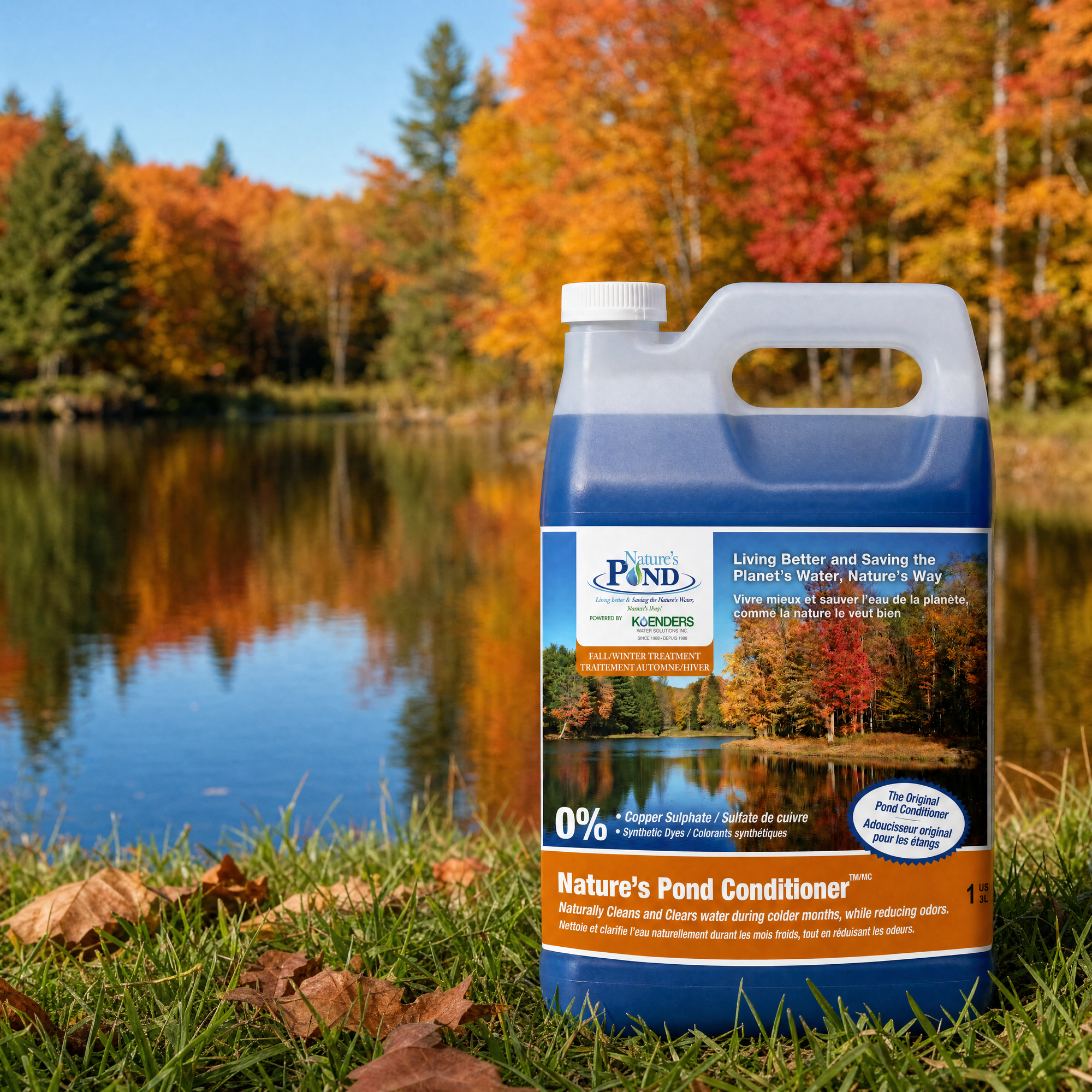
Think of it like a compost pile. The bacteria are the workers doing the actual eating and multiplying. The enzymes are the shredder that chops big, stubborn scraps into pieces small enough to eat. You want both working together, which is exactly why Nature's Pond Conditioner is formulated as a bacteria and enzyme blend rather than one or the other. For the full mechanism behind how these microbes clear a pond, see our complete guide to bacteria and enzymes for ponds.
Bacteria do the eating. Enzymes do the prep work. A blend gives you both in one step.
What beneficial bacteria are and what they do
Beneficial bacteria are microscopic, living organisms that consume the organic load fouling your pond: fish waste, dead leaves, uneaten feed, decaying plants, and the muck settling on the bottom. As they feed, aerobic strains convert those organics into carbon dioxide and water, the same clean end products you get from healthy digestion anywhere in nature.
Their second, quieter job is driving the nitrogen cycle. Fish waste and decay release ammonia, which is toxic to fish. Nitrifying bacteria convert ammonia to nitrite, then nitrite to less harmful nitrate, which plants and further bacterial action can use up. This is the invisible engine that keeps water safe and clear. Because bacteria are alive, they also reproduce: give them food, oxygen, and warm water and the population grows to match the workload, then holds that balance season after season.
There is one honest catch worth naming up front. The bacteria that digest muck fastest are aerobic, so they need dissolved oxygen. Drop the oxygen and they slow down or die back while the bottom turns anaerobic and starts producing that rotten-egg smell. That is why we always pair bacteria with aeration in the 3-step Renew, Revive, Remove program, and why oxygen is the single biggest lever on your results.
What enzymes are (hint: they are not alive)
Enzymes are proteins, not organisms. They are biological catalysts: molecules that dramatically speed up a specific chemical reaction without being alive and without reproducing. In a pond, added enzymes attack the toughest organic matter first, the cellulose in leaves and stems, the starches and proteins in waste, and fats, breaking those big, slow-to-rot molecules into smaller pieces.
Why enzymes speed the first breakdown of tough organics
Left alone, fibrous material like cattail stalks, grass clippings, and fallen leaves can sit on the bottom for a long time because it is chemically hard to break down. Enzymes lower the energy needed for that first cut, so the stubborn stuff gets reduced to bite-sized organics much faster. Once the material is broken down, the living bacteria can move in and finish the digestion. Enzymes essentially remove the bottleneck at the front of the line.
Do bacteria produce their own enzymes?
Yes. Bacteria naturally secrete enzymes as part of how they digest food, so a healthy bacterial population is already making some enzymes on its own. So why add more? Because supplemental enzymes give the whole process a head start, and that head start matters most exactly when the native population is small or sluggish: at spring startup, in cold water, or when you are facing a heavy muck load and want the tough fibrous layer broken down sooner. Enzymes on their own do not reproduce, so once they are consumed in the reaction they are gone. That is precisely why they are paired with bacteria for a lasting effect rather than sold as a standalone fix.
Pond bacteria vs enzymes at a glance
| Attribute | Bacteria | Enzymes |
|---|---|---|
| Living? | Yes, living microbes | No, non-living proteins |
| Job | Digest waste and reproduce, drive the nitrogen cycle | Catalyze and speed the first breakdown of tough organics |
| Best on | Ongoing organic load, ammonia and nitrite | Tough cellulose, starch, fats, and proteins |
| Reproduces? | Yes, multiplies while conditions hold | No, consumed in the reaction |
| Needs oxygen? | Aerobic strains do | Not living, but feeds aerobic digestion |
Why a blend beats either one alone
Used by themselves, each has a gap. Enzymes prep material fast but do not reproduce and cannot carry out the full digestion or process nitrogen, so on their own the effect fades as they are used up. Bacteria do the complete job and multiply, but they can be slow to chew through the toughest fibrous debris on their own, especially early in the season before the population builds.
A blend closes both gaps in sequence. The enzymes go to work immediately on the stubborn organics, and the bacteria follow to digest what the enzymes opened up, then keep multiplying to hold the balance. You get a faster start and a durable finish from a single application. This is the thinking behind the Renew step, the conditioning stage of the 3-step Pond Care Program, where the bacteria and enzyme blend goes in first to knock down the organic load.
- Enzymes shorten the lag at startup by breaking tough material down fast.
- Bacteria carry the load long term, digesting organics and processing ammonia and nitrite.
- Together they cover the full organic load in one product, which is why a blend outperforms buying either alone.
When each matters most
The blend is the right default year-round, but there are three situations where the enzyme half earns its keep the most:
- Spring startup. After a long winter your native bacterial population is at its lowest, and there is a season's worth of settled leaf and plant debris waiting. The enzyme boost helps break that backlog down while the bacteria rebuild.
- Heavy muck loads. If your bottom is thick with years of accumulated organic sludge, the fibrous, stubborn fraction is exactly what enzymes target first. For the bigger picture on tackling a mucky bottom, see how to get rid of pond muck.
- Cold or cooling water. As water cools, bacterial metabolism slows, so the front-end help from enzymes matters more. Timing and formula choice by temperature are covered in our guide to cold-water vs warm-water pond bacteria.
In every one of these cases the bacteria are still the workhorse. The enzymes just clear the path so the bacteria can get moving sooner. And in all cases, keeping the water oxygenated is what lets the whole system run at full speed, which is the aerobic pairing we cover in depth for beneficial bacteria and aeration.
So do you actually need to buy both?
For almost every acreage, farm, or backyard pond the practical answer is: buy one product that already contains both. You do not need to source a separate enzyme bottle and a separate bacteria bottle and try to time them. A quality conditioner is built as a blend so the enzymes and bacteria arrive together, in the right sequence, in a single dose. If you are still asking whether the whole biological approach delivers, we answer that skeptically and with evidence in do pond bacteria treatments actually work.
When you are ready to treat, our in-house pond experts will help you match the product and dose to your pond's size and depth at no charge. Reach out for a free recommendation rather than guessing, and browse the all-natural bacteria and enzyme conditioner to see what fits.
Frequently asked questions
Related
- Beneficial bacteria and enzymes for ponds The full guide to how they work
- Do pond bacteria treatments work? The honest, evidence-based answer
- Why beneficial bacteria needs oxygen The aeration pairing that decides results
- Get rid of pond muck naturally Break down heavy bottom sludge
- Nature's Pond Conditioner The bacteria and enzyme blend
- The 3-step Pond Care Program Renew, Revive, Remove
FAQ