 Canada
 United States
How-to
How to Clear and Keep a Large Pond, Lake, or HOA Community Water Clean (Without Harsh Chemicals)
A complete, chemical-free plan for green, smelly, or weed-choked large ponds, lakes, and HOA water: aerate, treat the muck biologically, and remove what's already there.
Last updated August 31, 2026
To clear a large pond, lake, or HOA waterbody without harsh chemicals, fix the root cause instead of the symptom: add bottom-up aeration to raise dissolved oxygen, use beneficial bacteria to digest the nutrient-rich muck feeding algae, and remove existing weeds and sludge mechanically. Copper-based algaecides kill algae that then sinks, rots, and refuels the next bloom.
The short answer
A big waterbody does not turn green, smelly, or weed-choked by accident. It happens when three things line up: too many nutrients (mostly phosphorus and nitrogen), not enough dissolved oxygen, and a layer of anaerobic muck sitting on the bottom. Chase the symptom with a chemical and you spend all season re-treating. Fix the cause and the water clears and stays clear.
The durable plan has three moves: aerate from the bottom up so the whole water column carries oxygen, treat biologically with beneficial bacteria and enzymes that digest the nutrient-rich muck, and remove the weeds and sludge that are already there. That is the backbone of the 3-step Pond Care Program: Renew, Revive, Remove. This guide walks through why large and shared water behaves the way it does, the full menu of options, and how to choose based on your pond's size, depth, and power access.
Why large ponds, lakes, and HOA water turn green, smelly, or weedy
The root cause: excess nutrients, low oxygen, and anaerobic sediment
Algae and aquatic weeds are not the disease. They are the symptom of a pond that is overfed and under-oxygenated. Runoff, grass clippings, goose droppings, fertiliser from surrounding lawns, and years of dead leaves all load a waterbody with phosphorus and nitrogen. Those nutrients collect in the soft black sediment on the bottom. When that sediment goes low on oxygen, it turns anaerobic, and an anaerobic bottom does two harmful things at once: it releases stored phosphorus back into the water to feed the next algae bloom, and it produces the rotten-egg gas (hydrogen sulfide) behind that swampy odor.
Green water and muck are what an overfed, oxygen-starved pond looks like. Fix the oxygen and the nutrients, and the symptoms fade on their own.
Why warmth and summer stratification make it worse
Warm water holds less dissolved oxygen than cold water, so summer is when a pond is most vulnerable. On top of that, a deeper waterbody tends to stratify: the sun warms the top few feet while the bottom stays cold, and the two layers stop mixing. The bottom layer runs out of oxygen, goes anaerobic, and becomes a nutrient factory. Then a cold front or heavy rain can suddenly mix those layers, crashing oxygen across the whole pond overnight. That is the mechanism behind a late-summer or fall pond turnover fish kill, and continuous bottom aeration is what prevents the sharp divide that makes it deadly.
Why large and shared water is different
A backyard water feature and a five-acre HOA lake have the same biology but very different logistics. Large water means more volume to oxygenate, greater depth, dead zones in lobes and coves that a single device cannot reach, and a bigger nutrient load draining in from a wider watershed. Shared water adds people: boards, budgets, multiple owners, and often a stormwater permit that makes maintenance a legal obligation, not a nice-to-have. That is why large and community waterbodies are best managed as a program on a schedule, not as a one-off product purchase. If your site is an acreage pond or a shared lake, see how we frame it for lakes and large ponds and for HOA and community ponds.
The full menu of options (and where each one fits)
There is no single silver bullet for a large waterbody. Each tool below does one job well. The durable results come from stacking the first three and using the rest as supporting players. A useful way to think about it: aeration changes the pond's chemistry, biology consumes the food supply that algae and weeds depend on, and mechanical removal deals with the backlog that has already accumulated. Skip any one of the three and the other two have to work harder for longer.
Aeration: the foundation
Aeration is the one move that changes the underlying chemistry. For anything more than a shallow decorative pond, bottom-up diffused aeration outperforms a surface fountain or paddle aerator, because it lifts water from the bottom, breaks up stratification, and carries oxygen all the way down to the sediment where the muck sits. That oxygenated bottom stops releasing phosphorus and stops making rotten-egg gas. For a deeper waterbody, a diffused bottom system is generally the right call over a surface unit; a common rule of thumb is that water deeper than roughly six feet benefits from a diffused bottom system, though the exact setup depends on your pond. Here is how pond aeration works in more depth.
Power access decides the type. Where you have shoreline electricity, an electric diffused system is simplest. Where the pond sits out on a pasture or acreage with no power line, off-grid windmill aeration runs on wind alone with no power bill and no trenching. Koenders, the parent company, has built windmill pond aerators since 1988 for exactly these remote sites. Solar is the third off-grid option where a site has strong sun but light wind.
Beneficial bacteria and enzymes: the biological engine
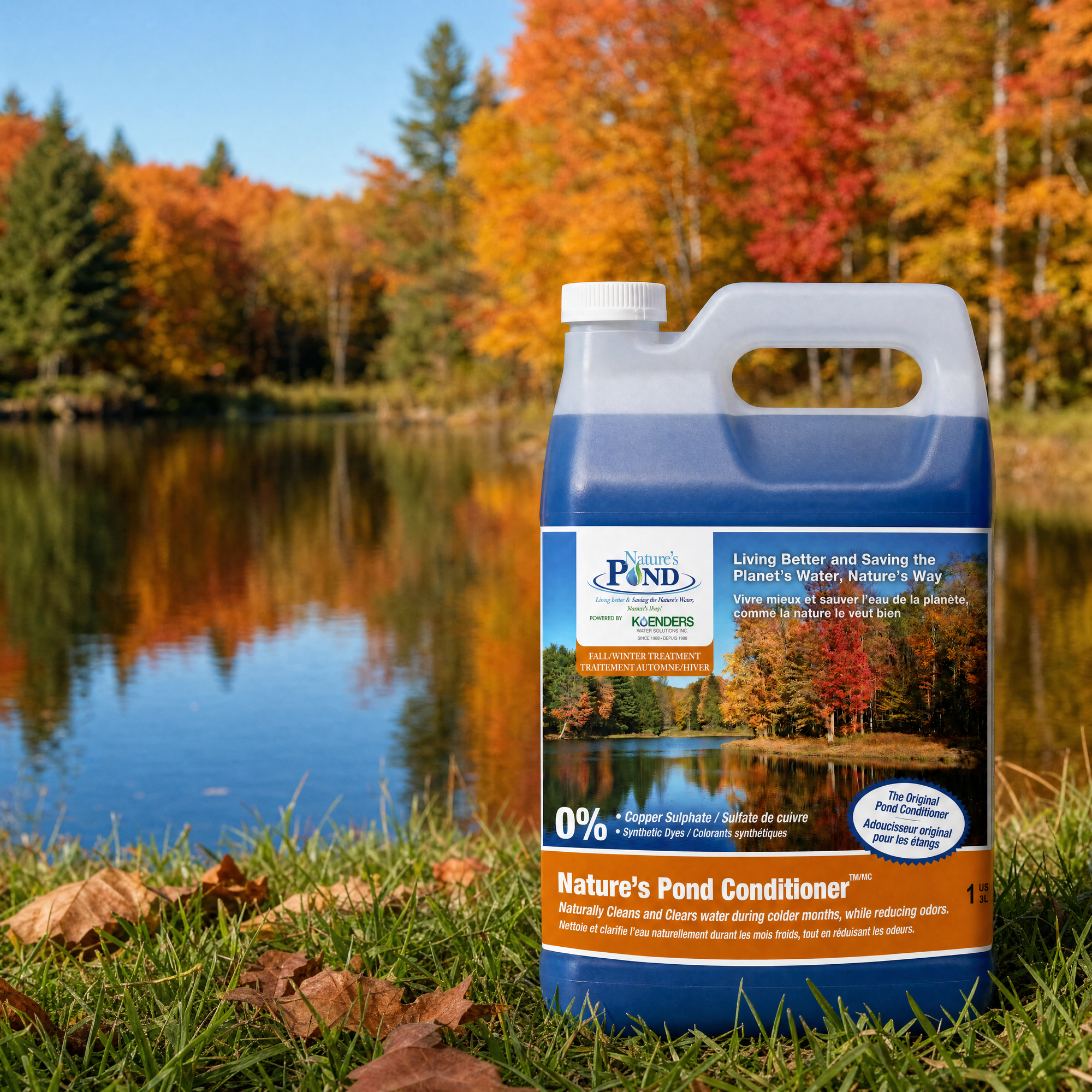
Aeration sets the table; beneficial bacteria eat the meal. Nature's Pond Conditioner is an all-natural blend of aerobic and anaerobic beneficial bacteria, enzymes, and plant extracts with a food-grade dye. Those microbes digest the organic muck and the excess nutrients that algae feed on, converting them to carbon dioxide and water. Starve algae of its food supply and blooms have nothing to grow on. The conditioner is non-pathogenic and safe for fish, pets, livestock, and wildlife when used as directed, which is what makes it appropriate for a shared or community pond where people and animals use the water.
The pairing matters: the bacteria that digest muck fastest are aerobic, so they need the oxygen that aeration provides. Run bacteria alone in a stagnant, oxygen-poor pond and they cannot do their best work. Run them together and each one makes the other more effective.
On a large or shared waterbody, consistency beats intensity. Beneficial bacteria are living organisms, so they respond to water temperature and to a steady supply of food and oxygen. A single dose dropped into a cold, stagnant spring pond does little; the same product applied on a maintenance schedule through a warm, well-aerated season steadily draws down the muck and the nutrient load. That is why we treat the biology as an ongoing program rather than a one-time treatment, and why the results compound over multiple seasons instead of fading in a week.
Manual and mechanical removal
Aeration and bacteria fix the cause, but they work over seasons, not overnight. If your water is already choked with weeds or carries a deep sludge blanket, physically taking material out speeds everything up and gives the biology a head start. A lake rake or weed cutter pulls rooted weeds and floating mats; for heavy sludge, a targeted removal reduces the organic load the bacteria then have to digest. Every pound of muck you remove mechanically is a pound the pond no longer has to break down.
Barley and grass carp: supporting roles
Barley straw and grass carp are sometimes used as supplemental tools. Both have real limits and are best treated as supporting players, not the plan. Grass carp in particular are permit-gated in most jurisdictions and are usually restricted to sterile triploid fish with capped stocking rates, so confirm your local rules before stocking anything. Neither one addresses the nutrient load or the low-oxygen bottom, which is why they belong on top of an aeration and biology program, not instead of it.
Algaecide and copper sulfate: a last resort
Copper-based algaecides kill algae fast, and on a big waterbody that speed is a trap. The dead algae sinks, rots, consumes oxygen as it decays, and releases its stored nutrients, which refuels the very next bloom. So you re-treat, and re-treat again. Meanwhile copper accumulates in the sediment over repeated applications, and in soft or low-alkalinity water copper can become toxic to fish. It manages the symptom while quietly making the underlying problem worse. If you want the full breakdown, see copper sulfate for pond algae and the lifetime cost of bacteria versus algaecide.
| Approach | What it does | Effect on muck and sediment | Recurring? | Permit exposure |
|---|---|---|---|---|
| Copper / algaecide | Kills living algae quickly | Adds dead biomass to the bottom; copper accumulates in sediment | Yes, typically all season | Often a regulated pesticide; may need a licensed applicator |
| Beneficial bacteria + aeration | Digests nutrients and muck; raises dissolved oxygen | Reduces the organic muck layer over time | Scheduled maintenance, but self-reinforcing | Generally not a regulated pesticide application |
| Mechanical removal | Physically pulls out weeds and sludge | Directly lowers the organic load | As needed, seasonally | Usually low; confirm for shared or connected waters |
The 3-step program for large and shared water: Renew, Revive, Remove
Here is how the tools above come together into a repeatable plan you can put on a schedule and defend to a board. This is the 3-step Pond Care Program applied to a large or shared waterbody.
- Renew (condition): dose beneficial bacteria and enzymes so the biology starts digesting the nutrient-rich muck and outcompeting algae for food. On a large waterbody this is a startup dose followed by maintenance doses through the warm season.
- Revive (aerate): install bottom-up diffused aeration sized to your surface area and depth so oxygen reaches the sediment and the pond stops stratifying. This is what keeps the bacteria working and prevents the turnover crash.
- Remove (mechanical + biological): physically take out the weeds and heavy sludge that are already there, then let the bacteria and oxygen keep the remaining organic layer shrinking over the seasons.
The order matters less than the fact that all three run together. Aeration without biology leaves the muck; biology without oxygen stalls; removal without the other two just delays the next buildup. On a large waterbody, the payoff is a pond that gets easier to manage every year rather than harder: as the muck layer shrinks and the water column stays oxygenated, the pond stops swinging between crisis and treatment and settles into a stable, clear equilibrium. That stability is exactly what a board or property manager wants, because it turns an unpredictable emergency line item into a planned annual budget.
What HOA, stormwater, and shared-lake owners must add
If you are on a board or manage a community property, the biology is only half the job. The other half is governance.
- Responsibility: In most communities the HOA owns ongoing maintenance of a shared or stormwater pond, frequently under a municipal stormwater permit. Confirm the specific obligation in your governing documents and local permit before you budget.
- Permits: Applying an algaecide or aquatic herbicide often requires a permit or a licensed applicator, and stocking grass carp is usually permit-gated. A biological and aeration program is generally not a regulated pesticide application, which is one practical reason communities lean on it.
- Liability: A dense bloom on shared water can be a duty-of-care issue. You cannot tell whether a bloom is toxic by looking at it, so a paint-like or pea-soup scum should be treated as potentially hazardous to pets, children, and livestock until it clears. See our guide to spotting toxic blue-green algae.
- Budget: Reactive care (treating blooms, fish kills, odor complaints, and eventual dredging emergencies) concentrates spend into painful spikes. A proactive program smooths the cost and usually lowers it over time. Our HOA pond management guide lays out the responsibility and budgeting framework in detail.
How to choose: a decision path by size, depth, power, and goals
Use these questions to narrow the right setup for your waterbody. When you want it sized properly, our in-house pond experts will do it for you at no charge rather than making you guess.
- How deep is it? Shallow, uniform water can sometimes get by with a surface unit. Once a waterbody exceeds roughly six feet in places, a diffused bottom system becomes the priority so oxygen reaches the sediment and the pond destratifies.
- Is there power at the shoreline? If yes, electric diffused aeration is simplest. If no, choose off-grid: a windmill where you have steady wind, or solar where you have strong sun.
- What is the shape? Long, lobed, or multi-basin water has dead zones a single diffuser cannot reach, so plan for multiple diffuser stations placed to cover the whole footprint.
- What is the goal? Clearing an existing green or weedy mess leans harder on mechanical removal up front; keeping already-decent water clear leans on aeration plus bacteria on a maintenance schedule.
- Who uses the water? Fish, pets, livestock, and swimmers make the fish-safe biological path the clear choice over chemicals.
Sizing a large or shared waterbody is not a place to guess, and the online calculators that used to float around are no substitute for a real assessment. Contact our pond experts for a free estimate and we will match aeration and a treatment schedule to your acreage, depth, and goals.
Clearing large water is a program, not a purchase. Aerate the bottom, feed the biology, remove what's already there, and keep it on a schedule.
Frequently asked questions
Related
- The 3-step Pond Care Program Renew, Revive, Remove for clear water
- Lakes and large ponds Solutions for acreage and large water
- HOA and community ponds Shared and stormwater pond care
- How pond aeration works Benefits, types, and sizing basics
- HOA pond management Board responsibilities and budgeting
- Contact our pond experts Free estimate for your waterbody
FAQ