 Canada
 United States
Seasonal guides
Farm Pond Algae Turning Green Every Summer? Livestock Water Safety and the Natural 3-Step Program
Why farm ponds go green every late summer, whether the algae is safe for your cattle, and the durable off-grid way to clear a big pond without harsh chemicals.
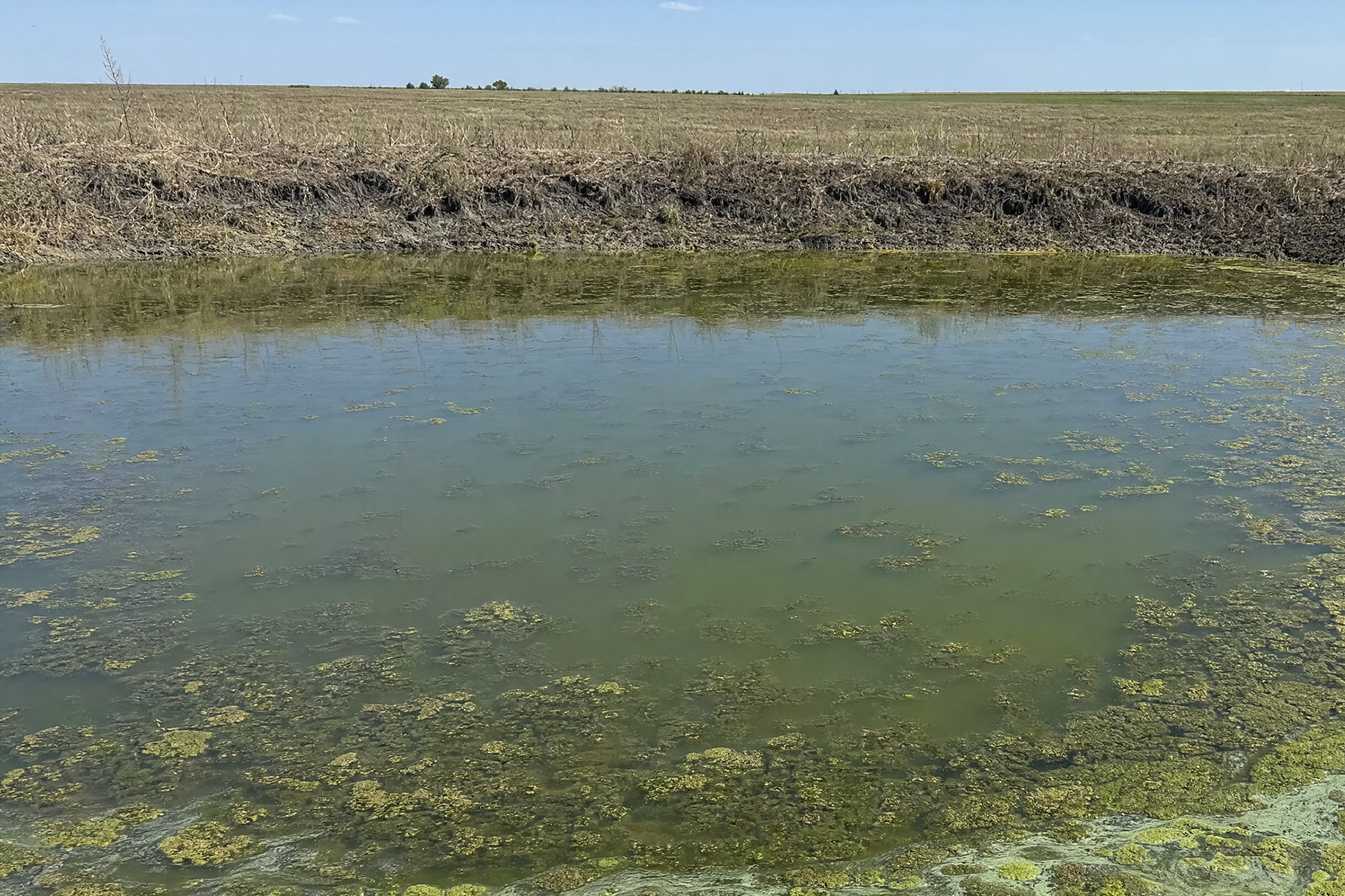
Farm ponds turn green in late summer when heat, low water and nutrient runoff from manure and fertilizer feed an algae bloom. Ordinary green or string algae is usually safe for livestock, but toxic blue-green algae is not, so keep cattle off any paint-like or scummy bloom. The durable natural fix is off-grid aeration plus beneficial bacteria.
The quick answer
If your farm pond turns pea-soup green every August, you are not doing anything wrong: heat, dropping water levels, and nutrient runoff from manure and fertilizer line up every summer to feed an algae bloom. Ordinary green and string algae are usually a nuisance rather than a poison for cattle, but toxic blue-green algae (cyanobacteria) is a genuine hazard, so any paint-like or scummy bloom means fence livestock off and provide alternate water until it clears.
The lasting fix is not a chemical you re-apply every few weeks. It is to treat the cause: aerate the pond so it stays oxygenated, and add beneficial bacteria to consume the excess phosphorus and nitrogen the algae feed on. On a pasture with no power at the water, off-grid windmill aeration does this on wind alone.
Why farm ponds turn green every late summer
A summer bloom is not random. The same handful of triggers show up on almost every acreage and cattle pond as the season heats up, and they all point back to nutrients plus stagnant, low-oxygen water.
Heat, low water, runoff and manure nutrients
As summer wears on, evaporation drops the water level and concentrates whatever nutrients are already in the pond. Rain events wash more in: manure from the herd loafing at the water's edge, fertilizer drift from nearby fields, and decaying plant matter. Algae are simple organisms that bloom fast when they get warm, sunlit water and a fresh load of phosphorus and nitrogen. Late summer stacks all three at once.
Stagnation and stratification in a stock pond
A pond with no circulation separates into layers in warm weather. The warm surface floats on a cold, oxygen-starved bottom, and that bottom goes anaerobic, which lets sediment release stored nutrients back into the water. This is the fuel line for the next bloom. It is also why a pond can smell of rotten eggs in a hot spell: an anaerobic bottom produces hydrogen sulfide gas. Breaking up that layering with bottom-up aeration is the single biggest lever you have on a recurring green pond.
Put those two together, warm concentrated nutrients up top and an anaerobic bottom releasing more, and you have a pond primed to bloom. It explains why the green often shows up in the same weeks every year and why it seems to arrive overnight: the algae were already present, and the late-summer conditions simply let them multiply fast.
Green every August is not bad luck. It is a nutrient-plus-stagnation problem that repeats until you fix the cause.
Is it safe for cattle to drink? The blue-green algae question
This is the question that actually matters on a working farm, and the honest answer depends on which kind of algae you have. Most of the time you are looking at nuisance algae. Sometimes you are not, and that is when it becomes a herd-health issue rather than a water-clarity issue.
Nuisance green or string algae vs toxic cyanobacteria
Ordinary planktonic green water and hair-like string algae are usually not toxic to livestock. They are a nuisance and a sign of an unbalanced pond, but cattle generally drink around them without harm. Toxic blue-green algae is different. Cyanobacteria can produce toxins that are dangerous, and documented cases include cattle deaths after drinking from ponds with heavy Microcystis blooms. The tricky part is that you cannot confirm toxins by sight alone, so the field rule is to judge by appearance and treat anything suspicious as a hazard.
The visual tell: string algae forms fibres you can lift out on a stick, while blue-green algae looks like spilled paint, a turquoise or greenish film, or thick pea-soup scum on the surface, often with a musty smell. When you are unsure whether a bloom is the toxic kind, our guide to spotting toxic blue-green algae walks through the field checks and what to do next.
- Looks like paint, foam, or thick surface scum, no fibres: treat as possible blue-green algae. Keep livestock off it.
- Hair-like strands you can pick up on a stick: filamentous string algae, a nuisance, not usually toxic.
- Uniform green cloudiness like pea soup: planktonic green water, a nuisance, but watch for a scummy surface layer forming.
- When genuinely unsure: assume the worst, fence the pond, and provide alternate water until it clears or is tested.
When to fence animals off and provide alternate water
If you see a paint-like or heavy scummy bloom, especially one blown into a downwind corner where cattle drink, fence that pond off and give the herd a clean alternate source: a trough, a tank, or another pond. Do not wait for an animal to get sick to make the call. Toxic blooms can appear and concentrate quickly, and the safest move on a suspicious bloom is always to keep animals out of the water and off the shoreline spray.
The natural 3-step program for a farm pond
Once the herd is safe, the goal is to stop the green from coming back rather than just knocking down today's bloom. That is exactly what the 3-step Pond Care Program is built for: Renew, Revive, Remove. It works with the pond's biology instead of shocking it, so it stays safe for fish, livestock and wildlife when used as directed.
Revive: aerate (windmill or solar for no-power sites)
Aeration is the foundation. Bottom-up diffused aeration raises dissolved oxygen and circulates the whole water column, which destratifies the pond and stops that anaerobic bottom layer from feeding blooms. On a remote pasture, the beauty of windmill aeration is that it needs no power line: it runs on wind alone, driving air down to diffusers on the pond floor. Where the site is sunny but calm, solar aeration is the off-grid alternative. Either way, bottom diffusers outperform surface splashing for destratifying a deeper stock pond.
Renew: condition with beneficial bacteria
Nature's Pond Conditioner is an all-natural blend of aerobic and anaerobic beneficial bacteria, enzymes, and plant extracts with a food-grade dye. Those bacteria consume the excess phosphorus and nitrogen that algae need, converting organics to carbon dioxide and water. Starve the algae of nutrients and the bloom loses its fuel. The catch, and we would rather be honest about it, is that the aerobic bacteria doing most of the work need oxygen, which is why conditioner and aeration are a pair, not an either-or. It is non-pathogenic and safe for fish, pets, livestock and wildlife when used as directed.
Remove: clear mats and manage nutrient inputs
Rake or net out heavy floating mats so they are not left to sink, rot, and recycle their nutrients. Then cut the inputs: keep manure and fertilizer runoff away from the shoreline where you can, fence a buffer of vegetation around the water, and avoid letting the herd churn the banks into the pond. Small changes on the shoreline reduce the nutrient load every rain event would otherwise deliver.
Clearing a 1-acre or bigger pond naturally
The program does not change on a big pond, it just scales. A one-acre stock pond needs enough aeration for its surface area and average depth, consistent beneficial bacteria through the warm season, and mechanical removal of the worst mats. Deeper and larger ponds usually need more air, and often more than one diffuser, so the volume of water matters as much as the acreage on the surface. Rather than guess, our aeration and algae guide explains how bottom aeration starves a bloom, and our in-house pond experts will size a system for your pond for free.
One safety note for a deep, mucky pond in hot weather: bring aeration on gradually rather than switching a big system to full output overnight, because rapidly mixing oxygen-poor bottom water can stress fish. Starting in cooler weather, or ramping up over days, avoids that.
Canadian and prairie timing: ice-off to late summer
On the prairies the pond's calendar drives the program. Beneficial bacteria are living organisms and slow down in cold water, so there is little point dosing heavily right at ice-off when the water is still near freezing. As the water warms into spring, restart conditioning and get the aerator running so the pond builds biology and oxygen before the summer heat arrives. Doing the work in spring is what prevents the August bloom, waiting until the pond is already green means playing catch-up all season.
This is a durable, made-in-North-America approach built for exactly these conditions, and it suits acreage and landowner ponds as well as portable stock tanks and troughs that green up on their own timeline.
The cheapest durable way to control a big-pond bloom
Over a single afternoon, a jug of algaecide is cheaper than an aeration system. Over several seasons, the maths flips. An algaecide kills the visible algae, which then sinks, rots, and releases the very nutrients that feed the next bloom, so you buy and apply it again and again. A one-time aeration system plus seasonal beneficial bacteria addresses the cause, so the pond needs less intervention each year rather than more. That is why aeration plus biology tends to win on lifetime cost, not just on safety.
There is a herd-management cost to the chemical path too. Every algaecide treatment carries the risk of an oxygen crash from the die-off, and copper does not simply disappear: it settles and can accumulate in the bottom sediment over repeated seasons. A biological program avoids adding a persistent metal to water your cattle drink, and it leaves the pond healthier each year instead of more dependent on the next dose.
| Approach | Upfront cost | Ongoing cost | Livestock safety | Durability |
|---|---|---|---|---|
| Repeat copper or algaecide | Low per treatment | Recurring, every rebound | Narrow margin, dead algae can crash oxygen and stress fish | Temporary, bloom refuels from decaying algae |
| Aeration plus seasonal beneficial bacteria | Higher one-time system cost | Low, mostly seasonal conditioner | Fish, pet and livestock safe when used as directed | Durable, removes the nutrients driving the bloom |
Your next step
Get the herd safe first: if the bloom looks like paint or scum, fence it and offer clean water. Then treat the cause with the 3-step Pond Care Program so next August looks different from this one. Not sure what your pond needs or how big an aerator to run? Talk to our pond experts for a free sizing estimate and we will build a plan around your acreage, depth and water source.
Written by
Nature's Pond Care Team
Pond care experts
Keep reading
Related articles
Seasonal guides
Why Your Pond Turns Green Every Summer, and How to Stop the Bloom
Every July your pond goes green again. Here is why summer triggers the same algae bloom, and how to break the cycle naturally instead of chasing it.
Nature's Pond Care Team9 min read
Seasonal guides
The Complete Seasonal Pond Care Calendar
A simple month-by-month rhythm for a healthy pond, what to do in spring, summer, fall and winter to stay ahead of problems.
Nature’s Pond Care Team8 min read
Seasonal guides
Fall Pond Prep: Protecting Water Quality Through Winter
What you do in fall decides how your pond looks next spring. A short checklist to set your water up for a healthy winter.
Nature’s Pond Care Team7 min read
Get started
Put it into practice
Start with the conditioner, add aeration, and let nature do the rest.